
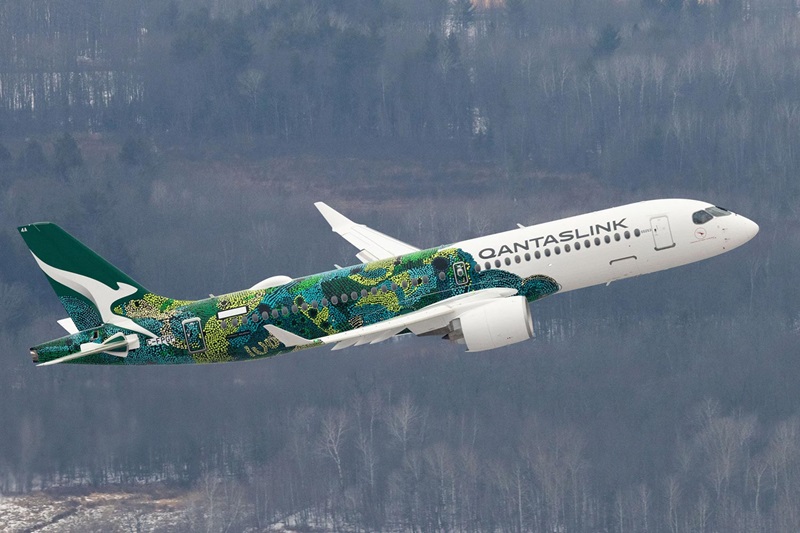
One could be forgiven for wondering where the Airbus A220 suddenly came from. Normally, new aircraft models are years in the planning, designing, and marketing, and we follow their progress as they edge closer to commercial service. The A220 is also a clear departure from Airbus’s usual naming convention that began with the A300, so the obvious question is: where did the A220 come from?
The answer lies in Canada in the early 1990s. Bombardier Inc., which began life building snowmobiles and grew into a major producer of regional airliners, business jets, and mass‑transit equipment, saw a gap above its CRJ (Canadair Regional Jet) family. The company believed there was room for a larger, more efficient jet in the 100–150 seat market—an aircraft that could sit between traditional regional jets and the smallest “mainline” narrow‑bodies.
The Airbus A220 was originally a Bombardier product, launched as the C Series, and designed to bring new levels of efficiency, comfort, and performance to this underserved segment.
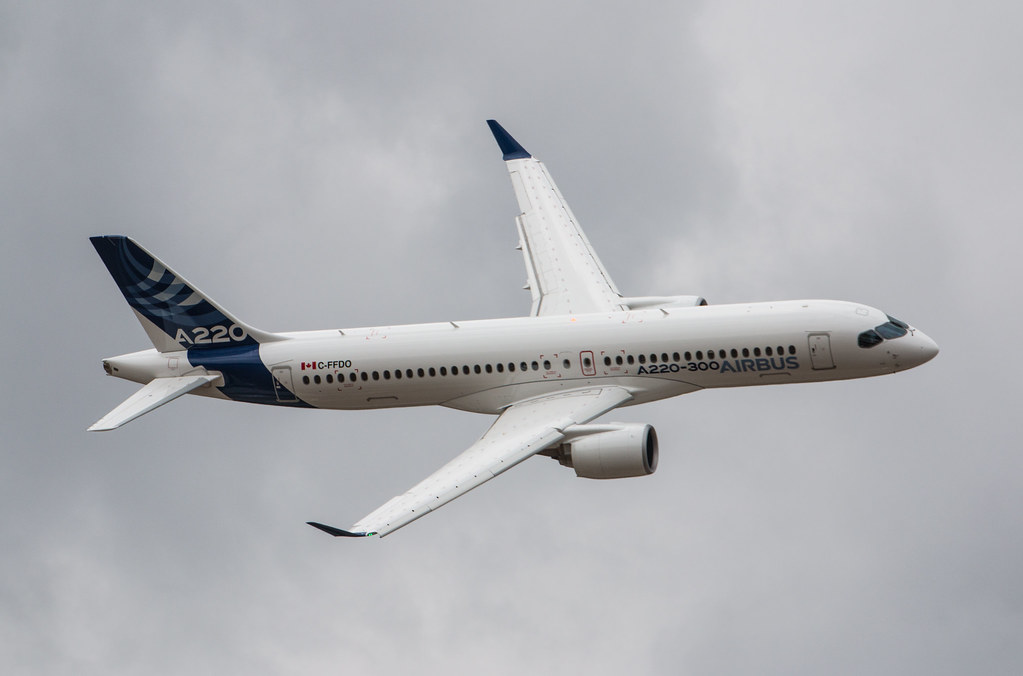
The Airbus A220 — originally born as the Bombardier C Series — a modern, efficient jet that reshaped the 100–150 seat market.

Development History
Bombardier briefly explored acquiring Dutch manufacturer Fokker in early 1996, which would have given them the F‑100 as a ready‑made solution. But by March that year, the deal was abandoned and Fokker went bankrupt. Bombardier instead chose to pursue its own clean‑sheet design.
On 8 September 1998, Bombardier launched the BRJ‑X (Bombardier Regional Jet Expansion) project. This early concept aimed to bridge the gap between the CRJ family and larger 2×3 narrow‑bodies like the Boeing 717 and Airbus A318. The BRJ‑X featured under‑wing engines and a wider cabin than the CRJ, but by the end of 2000 the project was shelved in favour of stretching the CRJ‑700 into the CRJ‑900.
The idea, however, refused to die. On 8 March 2004, Bombardier revived the concept as a new feasibility study for what would become the C Series. Two variants were planned: the CS100 and the larger CS300. Both would offer a 2×3 cabin layout, a range of around 3,200 NM, and a modern, comfortable interior with full stand‑up headroom. Fly‑by‑wire controls, side‑sticks, and a significant use of composite materials were all part of the design.
By May 2005, development costs were estimated at US$2.1 billion, supported by the Governments of Canada, Québec, and the United Kingdom. Bombardier’s Belfast facility—formerly Shorts Brothers—was selected to build the wings, engine nacelles, and composite empennage, while other major structures were assigned to facilities in Québec and China.
The C Series programme progressed through the late 2000s and early 2010s, culminating in the first flight of the CS100 in September 2013. Despite delays, engine issues, and financial pressure, the aircraft proved itself in testing with excellent fuel burn, low noise, and strong performance from short runways.
In 2017, Airbus took a majority stake in the C Series programme, bringing global support, sales reach, and production stability. On 10 July 2018, the CS100 and CS300 were officially rebranded as the Airbus A220‑100 and A220‑300, marking the aircraft’s transition into the Airbus family.
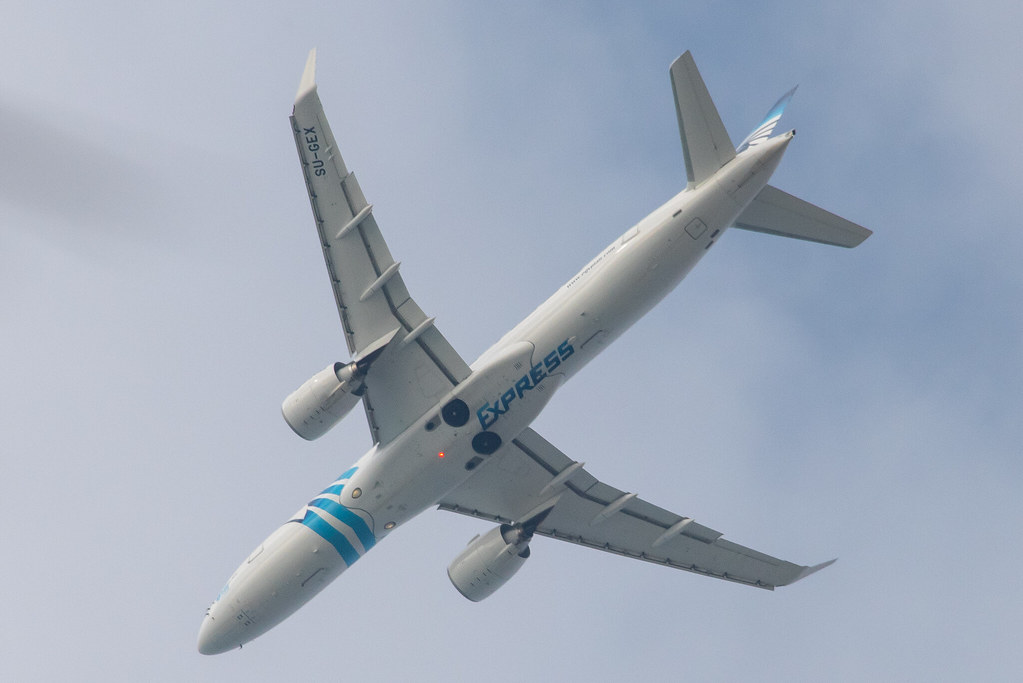
EgyptAir was one of the early adopters of the Airbus A220, showcasing the type’s efficiency and passenger comfort on regional routes.
Assembly
Wings – Belfast, Northern Ireland: The A220’s advanced composite wings are manufactured at the former Shorts Brothers facility in Belfast. These wings use resin‑transfer infusion techniques to produce a strong, lightweight structure that contributes significantly to the aircraft’s fuel efficiency.
Fuselage Sections – China and Canada: The forward, mid, and aft fuselage barrels are produced by a combination of suppliers, including Shenyang Aircraft Corporation in China and Bombardier’s own facilities in Québec. These sections are shipped to the final assembly line for integration.
Final Assembly – Mirabel, Québec: The primary A220 final assembly line is located at Mirabel Airport. Here, the fuselage sections, wings, landing gear, and empennage are joined, followed by installation of the Pratt & Whitney PW1500G geared turbofan engines, avionics, and interior components.
Final Assembly – Mobile, Alabama: To support U.S. airline demand, Airbus opened a second A220 assembly line in Mobile. This facility produces aircraft primarily for North American customers, mirroring the processes used in Mirabel.
The A220’s assembly process reflects its clean‑sheet origins: extensive use of composites, modern manufacturing techniques, and a high level of systems integration. The result is an aircraft that delivers excellent fuel burn, low noise, and strong performance from short or hot‑and‑high runways.
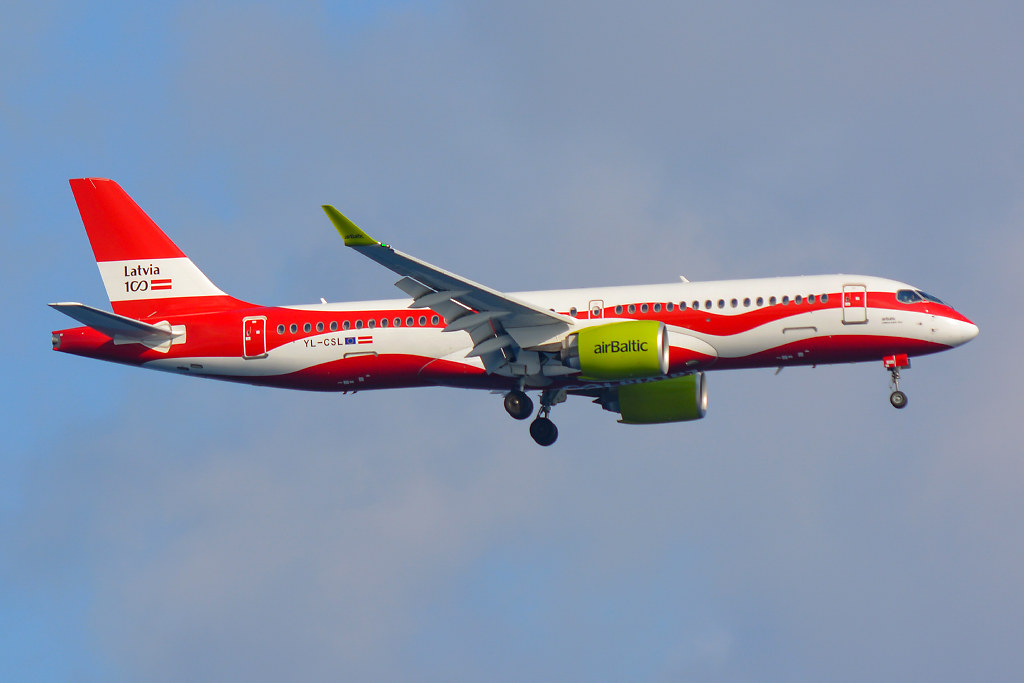
airBaltic operates one of the world’s largest Airbus A220 fleets, using the type as the backbone of its modern, fuel‑efficient network.
Specifications
| Specification | A220‑100 | A220‑300 |
|---|---|---|
| Length | 35.0 m (114 ft 9 in) | 38.7 m (127 ft 0 in) |
| Wingspan | 35.1 m (115 ft 2 in) | 35.1 m (115 ft 2 in) |
| Height | 11.5 m (37 ft 8 in) | 11.5 m (37 ft 8 in) |
| Cabin Width | 3.28 m (10 ft 9 in) | 3.28 m (10 ft 9 in) |
| Typical Seating | 100–120 passengers | 130–150 passengers |
| Maximum Seating | 135 | 160 |
| Range | 3,450 NM (6,390 km) | 3,550 NM (6,570 km) |
| Engines | 2 × Pratt & Whitney PW1521G | 2 × Pratt & Whitney PW1524G |
| Thrust | 21,000 lbf (93 kN) | 23,300 lbf (104 kN) |
| Cruise Speed | Mach 0.78 | Mach 0.78 |
| Maximum Takeoff Weight | 60,800 kg (134,000 lb) | 70,900 kg (156,000 lb) |
Programme Timeline
| Year | Milestone |
|---|---|
| 1996 | Bombardier considers acquiring Fokker; deal collapses. |
| 1998 | BRJ‑X project launched as a larger regional jet concept. |
| 2000 | BRJ‑X shelved; Bombardier focuses on CRJ‑900 stretch. |
| 2004 | C Series feasibility study launched (CS100 & CS300). |
| 2005 | Development costs estimated at US$2.1 billion; government support confirmed. |
| 2013 | First flight of the CS100. |
| 2016 | CS100 enters commercial service with Swiss International Air Lines. |
| 2017 | Airbus acquires majority stake in the C Series programme. |
| 2018 | C Series officially rebranded as Airbus A220‑100 and A220‑300. |
| 2019 | A220 final assembly line opens in Mobile, Alabama. |
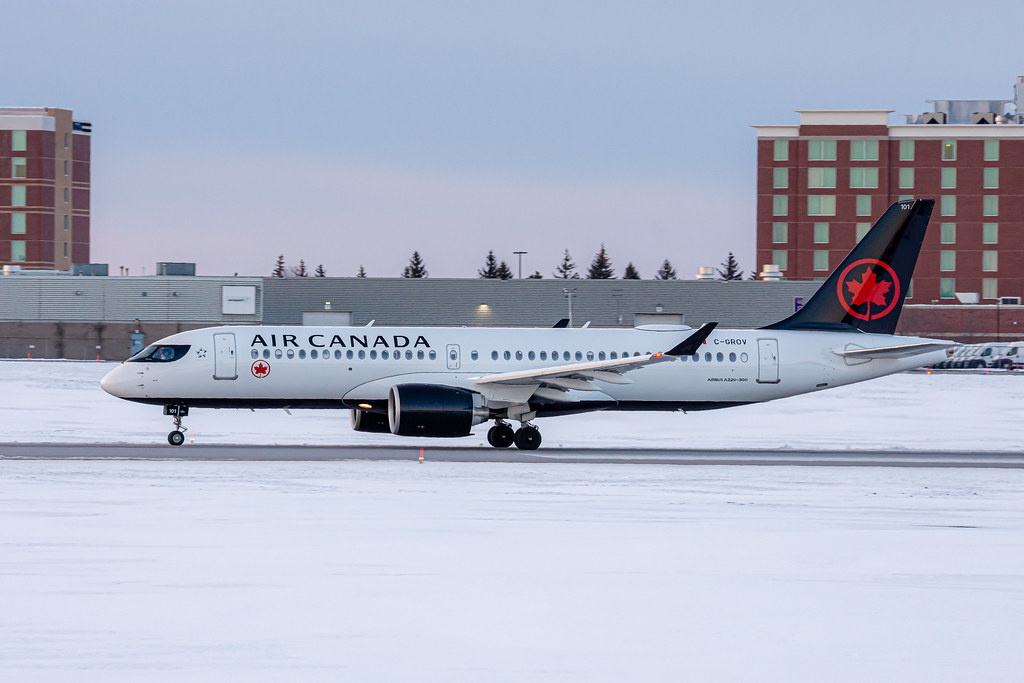
Air Canada’s Airbus A220 brings a modern, quiet, and fuel‑efficient regional jet to the airline’s North American network.
Cabin & Comfort
2–3 Seating Layout: The A220 uses an efficient 2–3 configuration, avoiding the cramped 3–3 layout found on larger narrow‑bodies. This means fewer middle seats and a more spacious feel throughout the cabin.
Wider Seats: Economy seats on the A220 are typically 18.5 inches wide—among the widest in the industry for a single‑aisle aircraft. This extra width is noticeable on longer flights and contributes to the A220’s reputation for comfort.
Large Windows: The A220 features oversized windows that are positioned higher on the fuselage, allowing more natural light and better outside visibility. Passengers often comment that the cabin feels more like a small wide‑body than a regional jet.
Quiet Cabin: Thanks to the Pratt & Whitney PW1500G geared turbofan engines and advanced aerodynamics, the A220 is significantly quieter than older aircraft in its class. This reduces fatigue on longer flights and improves the overall passenger experience.
Modern Overhead Bins: The A220’s overhead bins are designed to accommodate standard carry‑on luggage wheels‑first, increasing storage capacity and speeding up boarding.
LED Lighting: Full‑colour LED cabin lighting allows airlines to create mood settings for boarding, meal service, and rest periods, enhancing the onboard atmosphere.
Overall, the A220’s cabin sets a new benchmark for comfort in the 100–150 seat market, offering a spacious, quiet, and modern environment that passengers consistently rate highly.
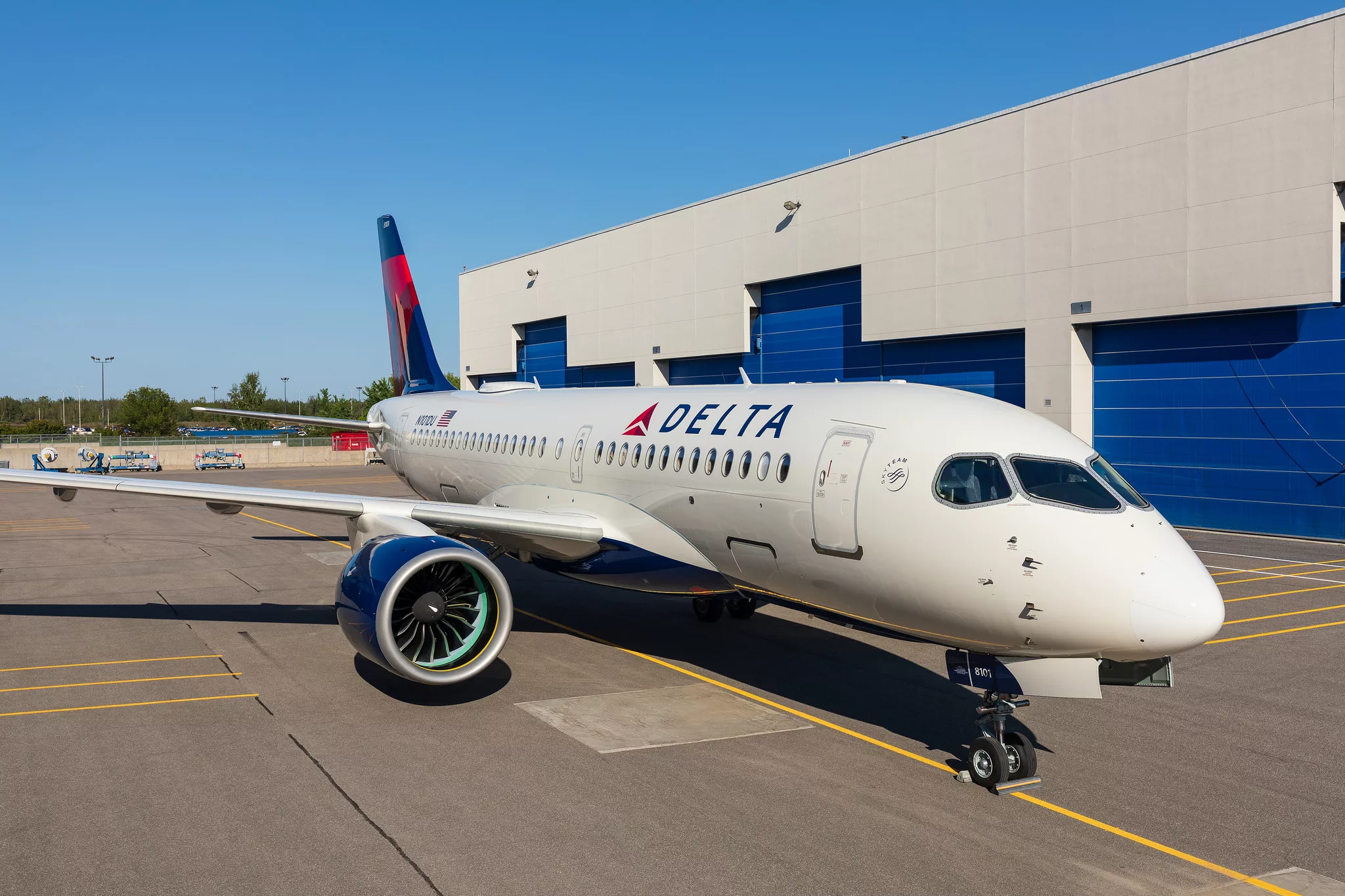
Delta’s Airbus A220‑100 showcasing the airline’s modern short‑haul fleet.
Engines & Performance
Geared Turbofan Architecture: The PW1500G uses a reduction gearbox that allows the large front fan to rotate at a slower, more efficient speed while the core spins faster. This improves propulsive efficiency, reduces fuel burn, and lowers noise levels compared to conventional turbofan designs.
Fuel Efficiency: The A220 achieves up to 20% lower fuel burn than the older aircraft it replaces, such as the Boeing 717, MD‑80 series, and early A319/737 models. This makes it one of the most economical aircraft in the 100–150 seat category.
Low Noise Footprint: Thanks to the GTF engines and aerodynamic refinements, the A220 is significantly quieter than previous‑generation jets. Its noise footprint is up to 50% smaller, making it ideal for airports with strict noise regulations.
Short‑Field Performance: The A220’s high‑lift wing, efficient engines, and low weight allow it to operate from shorter runways than many competing aircraft. This opens up new route opportunities for airlines and enables service to airports with operational constraints.
Range and Flexibility: With a range of up to 3,550 NM (6,570 km), the A220‑300 can comfortably handle transcontinental missions, while the A220‑100 excels on thinner regional routes. This flexibility has made the A220 popular with both legacy carriers and low‑cost airlines.
Overall, the combination of advanced aerodynamics and the PW1500G engines gives the A220 a performance profile that sets it apart from older narrow‑bodies, offering airlines lower operating costs and passengers a quieter, smoother ride.
Market & Competition
Replacing Ageing Fleets: Airlines around the world have used the A220 to replace older, fuel‑hungry aircraft. Its combination of low operating costs, long range, and excellent passenger comfort makes it an attractive option for both regional and mainline operations.
Competition with Embraer: The A220’s closest competitor is the Embraer E2 family, particularly the E195‑E2. While the E2 is highly efficient, the A220 offers a wider cabin, greater range, and higher seating capacity, giving it an edge for airlines seeking flexibility across route networks.
Competition with Larger Narrow‑Bodies: In some markets, the A220 competes indirectly with the Airbus A319neo and Boeing 737‑7. However, these aircraft are heavier, more expensive to operate, and often oversized for thinner routes. The A220’s lighter structure and geared‑turbofan engines give it a significant efficiency advantage.
Network Flexibility: One of the A220’s greatest strengths is its ability to operate both short regional hops and long transcontinental sectors. This allows airlines to open new point‑to‑point routes that would not be viable with larger aircraft.
Growing Global Adoption: Carriers such as airBaltic, Air Canada, Delta Air Lines, Swiss, and EgyptAir have integrated the A220 as a core fleet type. Its strong economics and passenger appeal have helped drive steady order growth since the programme joined Airbus.
Overall, the A220 has carved out a dominant position in the 100–150 seat category, offering airlines a modern, efficient, and flexible aircraft that outperforms many of its direct and indirect competitors.
Orders & Deliveries (as of May 2026)
| Variant | Orders | Deliveries | Backlog |
|---|---|---|---|
| A220‑100 | 108 | 75 | 33 |
| A220‑300 | 1001 | 442 | 560 |
| A220 Family Total | 1109 | 517 | 593 |
Airbus A220 Orders & Deliveries by Airline (click to expand)
| Airline | Country | A220‑100 | A220‑300 | ||||
|---|---|---|---|---|---|---|---|
| Ord | Del | Opr | Ord | Del | Opr | ||
| Governments, Executive and Private Jets | Various | 8 | 5 | 5 | 2 | ||
| Air Austral | France | 3 | 3 | 3 | |||
| AirBaltic | Latvia | 90 | 50 | 55 | |||
| Air Canada | Canada | 65 | 44 | 44 | |||
| Air France | France | 60 | 56 | 56 | |||
| Air Lease Corporation | United States | 9 | 9 | 36 | 36 | ||
| Air Tanzania | Tanzania, United Republic of | 4 | 4 | 4 | |||
| Air Vanuatu | Vanuatu | 2 | 1 | ||||
| Aviation Capital Group | United States | 20 | 5 | ||||
| Azorra Aviation | United States | 28 | 14 | ||||
| Breeze Airways | United States | 90 | 50 | 57 | |||
| Carlyle Aviation Partners | United States | 1 | 1 | ||||
| Croatia Airlines | Croatia | 2 | 6 | ||||
| Delta Air Lines | United States | 45 | 45 | 45 | 100 | 40 | 42 |
| Egyptair | Egypt | 12 | 12 | ||||
| GTLK | Russian Federation | 6 | 6 | ||||
| Ibom Air | Nigeria | 10 | 1 | 2 | |||
| Iraqi Airways | Iraq | 5 | 5 | 5 | |||
| ITA Airways | Italy | 7 | 7 | 12 | 19 | ||
| Jetblue Airways | United States | 100 | 65 | 65 | |||
| Korean Air | Korea, Republic of | 10 | 10 | 10 | |||
| Macquarie Financial Holdings PTY Limited | Australia | 20 | 4 | ||||
| Nordic Aviation Capital | Denmark | 2 | 2 | ||||
| QANTAS Airways | Australia | 29 | 12 | ||||
| Swiss | Switzerland | 9 | 9 | 9 | 21 | 21 | 21 |
| Undisclosed | 39 | 9 | |||||
The Airbus A220 continues to prove itself as one of the most efficient and comfortable narrow‑body aircraft in service today. With strong orders from major carriers such as Delta, Air Canada, Air France and AirBaltic, the type has firmly established its place in the global fleet. As deliveries accelerate and new operators join the program, the A220’s blend of performance, economics and passenger appeal ensures it will remain a key part of airline strategies well into the next decade.