
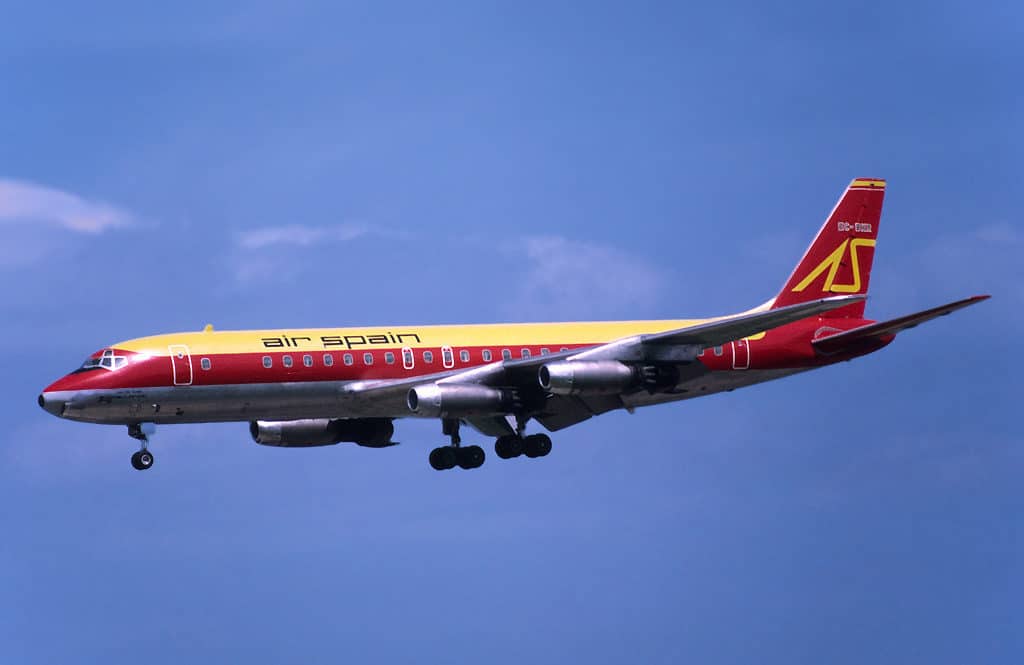
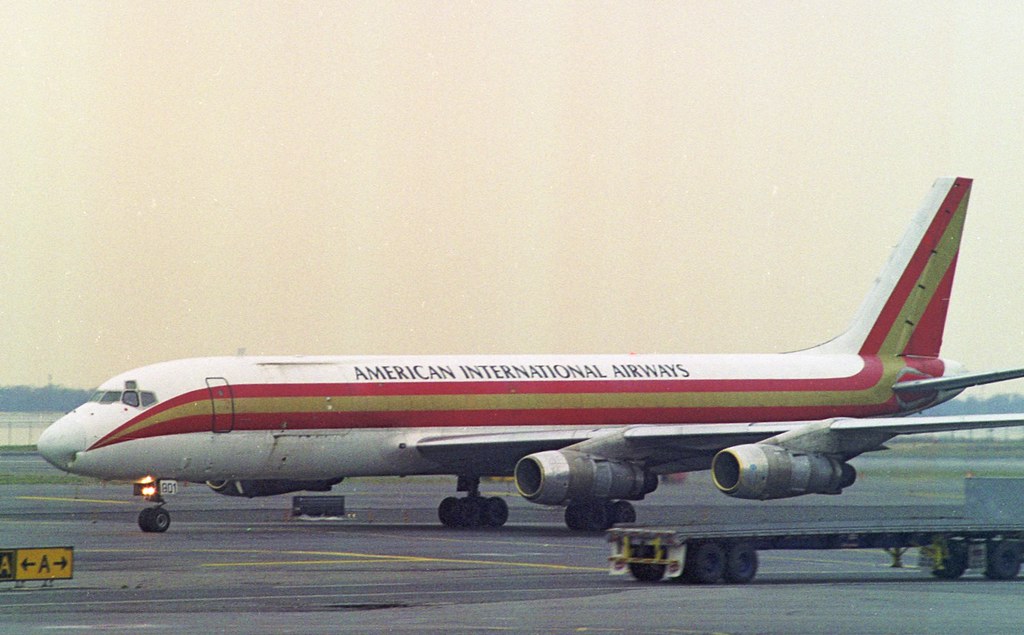
The Douglas DC‑8 marked the company’s entry into the jet airliner age. With four jet engines and sleek, modern lines, the DC‑8 quickly became one of the defining aircraft of early long‑range jet travel. Alongside the Boeing 707, its direct competitor, the DC‑8 symbolised the arrival of fast, reliable international air travel and trans‑continental service within the United States.
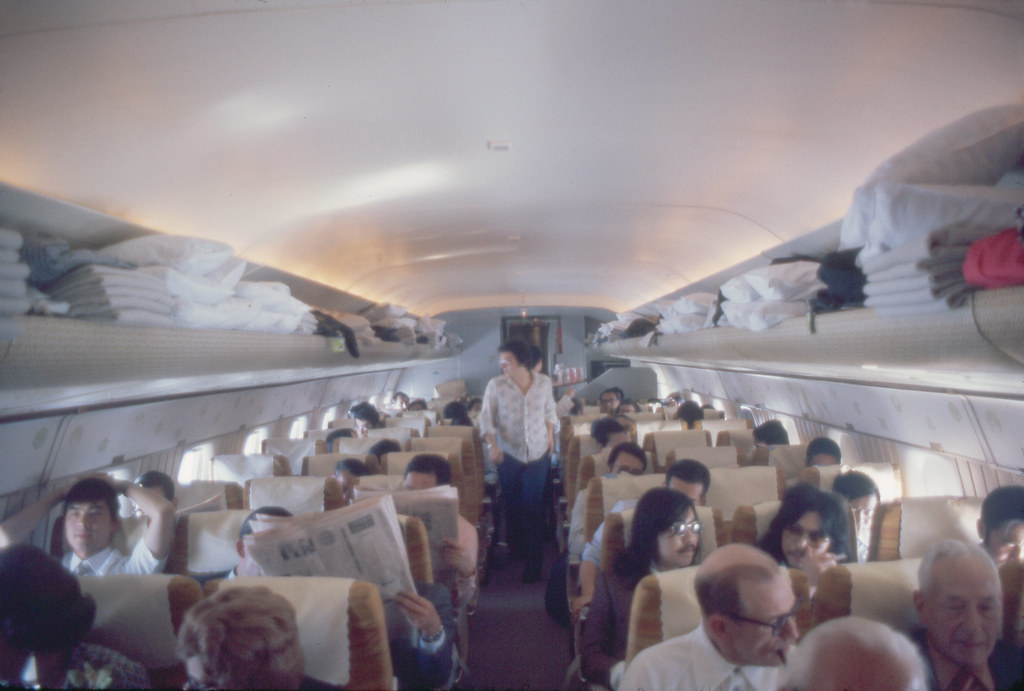
Compared to the piston‑engine and turboprop aircraft of the era, the DC‑8 offered a completely new passenger experience. Its wider cabin, arranged with six seats abreast in economy, provided travellers with more space, comfort, and a sense of modernity that helped usher in the jet age.
The Douglas DC‑8 — later referred to as the McDonnell Douglas DC‑8 following the 1967 merger — became one of the glamour intercontinental airliners of its time. The aircraft first flew on 30 May 1958 and remained in production until 1972, with a total of 556 built.

Douglas DC‑8 At‑a‑Glance
| Quick Summary | |
|---|---|
| Manufacturer | Douglas Aircraft Company (later McDonnell Douglas) |
| First Flight | 30 May 1958 |
| Production Years | 1958 – 1972 |
| Total Built | 556 aircraft |
| Primary Role | Long‑range narrow‑body jet airliner |
| Engines | Four Pratt & Whitney JT3C / JT3D series (later CFM56‑2 on DC‑8‑70) |
| Typical Cruise Speed | Mach 0.82 (483 knots / 895 km/h) |
| Passenger Capacity | Varies by series: 177 – 259 seats |
| Notable Variants | Series 10, 20, 30, 40, 50, Super 60 (‑61/‑62/‑63), Super 70 (CFM56) |
| Key Operators | United, Delta, Eastern, Air Canada, Japan Airlines, KLM, Pan Am |
| Legacy | One of the jet age’s defining long‑range airliners; many later converted to freighters |
Development Timeline
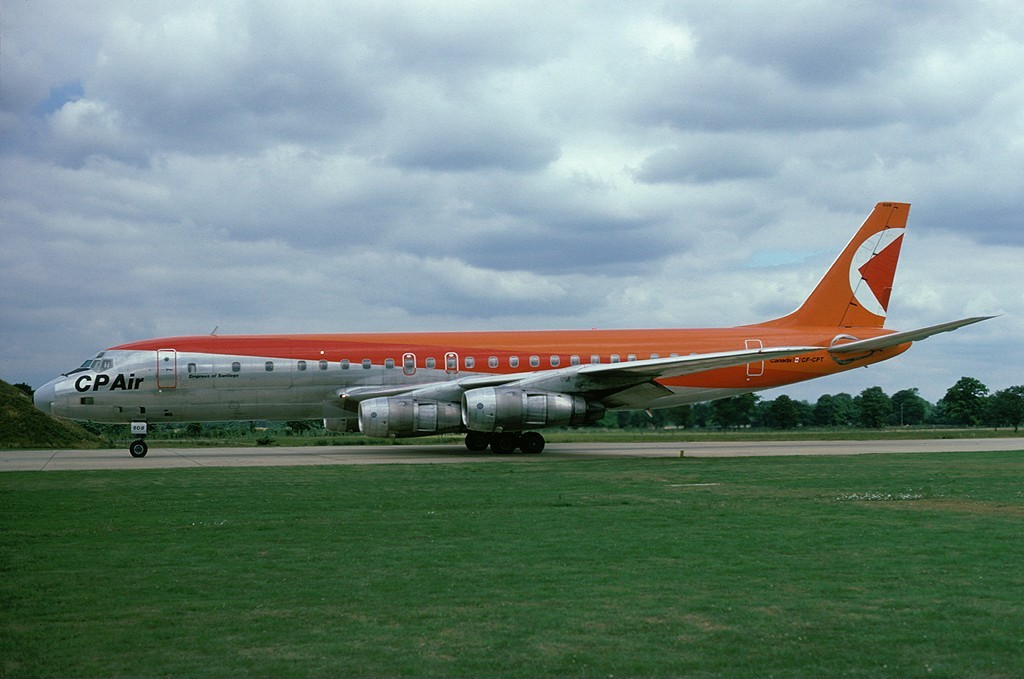
The Douglas DC‑8 marked the company’s entry into the jet airliner market, but this transition did not come quickly. Through the late 1940s and early 1950s, Douglas remained focused on piston‑engine airliners, enjoying enormous success with the DC‑2, DC‑3, DC‑4, DC‑5, DC‑6, and DC‑7. With more than 300 orders for the DC‑6 alone, Douglas saw little reason to pursue pure jets.
When de Havilland launched the Comet in 1949, Douglas still felt no urgency to change direction. The Comet’s early fatal accidents — later traced to metal fatigue — reinforced Douglas’s belief that piston and turboprop aircraft were the safer and more reliable path. The arrival of advanced turboprops such as the Vickers Viscount, Bristol Britannia, and Lockheed Electra further encouraged Douglas to continue refining existing technology.
Meanwhile, Boeing was already exploring jet airliner concepts. Drawing on experience with military bombers and aerial refuelling aircraft, Boeing began studies around 1949. When they approached airlines in 1950, the response was lukewarm — but Boeing pressed ahead regardless.
Douglas eventually recognised that pure jets were the future. In 1952 they began secret studies, and by mid‑1953 they had developed a design remarkably close to the final DC‑8. This early configuration seated 80 passengers in a five‑abreast layout, used four Pratt & Whitney JT3C engines, had a weight of 86,000 kg (190,000 lb), and offered a range of 4,800–6,400 km (2,592–3,456 NM).
Airlines immediately pressured Douglas to widen the fuselage to allow six‑abreast seating. This required lengthening the fuselage and increasing wing area, shaping the DC‑8 into the aircraft that would eventually enter service.
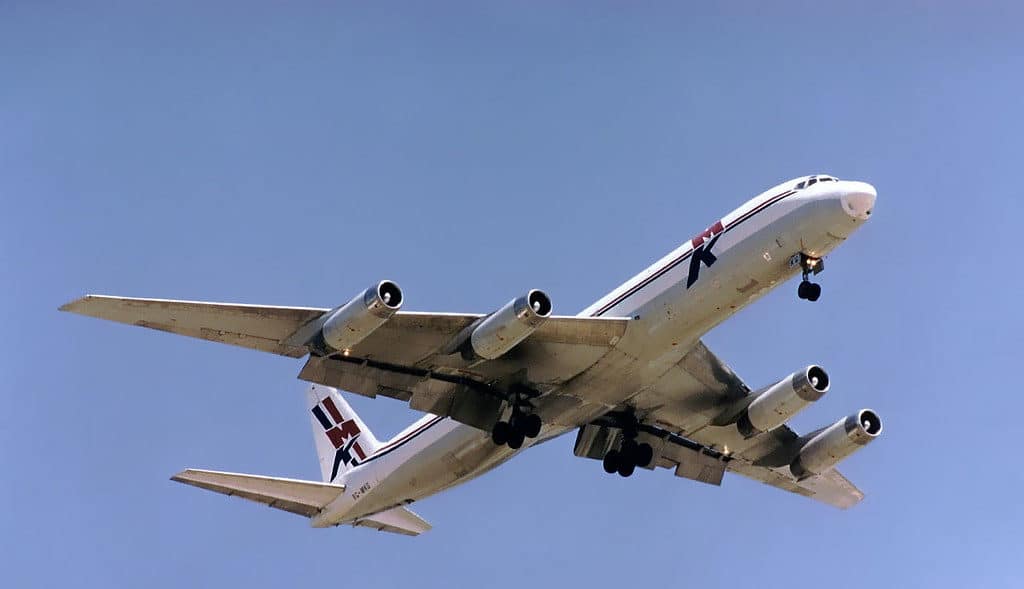
In July 1955, Douglas announced it would produce four DC‑8 variants. The differences would be limited to fuel capacity and engine options — fuselage length, wingspan, and wing area would remain identical across all versions. Airlines wanted multiple fuselage lengths, but Douglas refused, nearly costing them the full potential of the DC‑8’s market success.
The pure jet age transformed airline thinking. Initially, carriers were reluctant to adopt jets due to higher purchase and maintenance costs. But competitive pressure quickly changed attitudes: once one airline embraced jets, others had no choice but to follow.
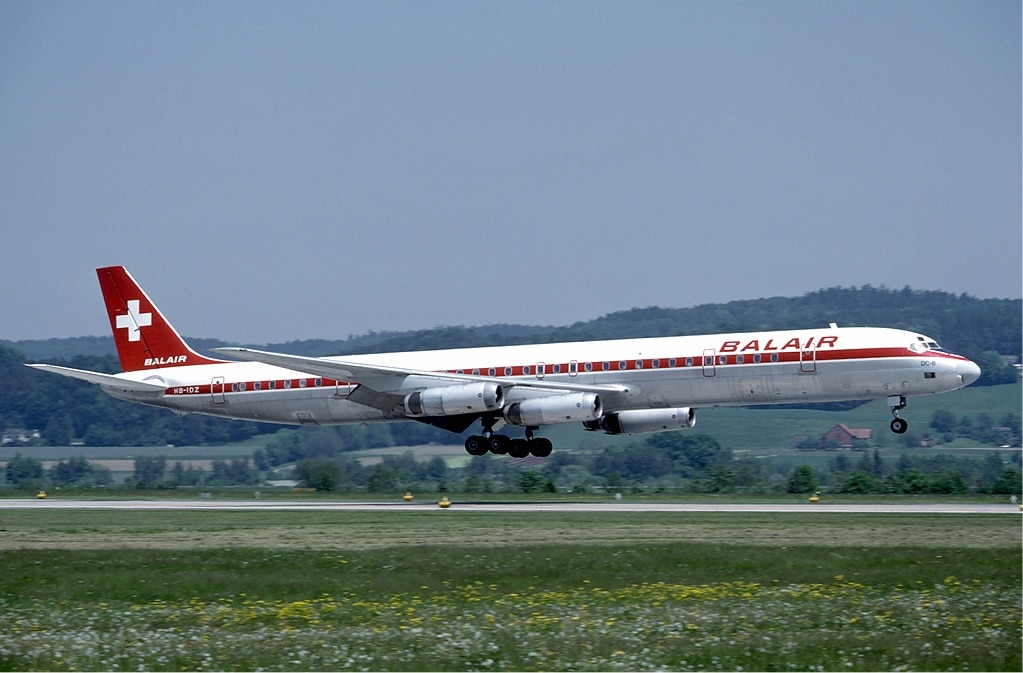
History
In October 1955, Pan American World Airways broke with tradition and ordered both the DC‑8 and the Boeing 707. Their order included 25 DC‑8s and 20 707s. By 1956, United Airlines, National Airlines, KLM, Eastern Air Lines, Japan Air Lines, and Scandinavian Airlines System (SAS) had also placed DC‑8 orders. By early 1958, Douglas held orders for 133 DC‑8s, while Boeing had secured 150 orders for the 707. At that time, a domestic DC‑8 cost US$5.46 million.
With a strong order book, Douglas planned to build the DC‑8 at its Santa Monica plant and requested a runway extension. Although the project promised new jobs and economic growth, local residents objected to jet operations in their neighbourhood, and the request was denied. Douglas relocated DC‑8 production to Long Beach Airport.
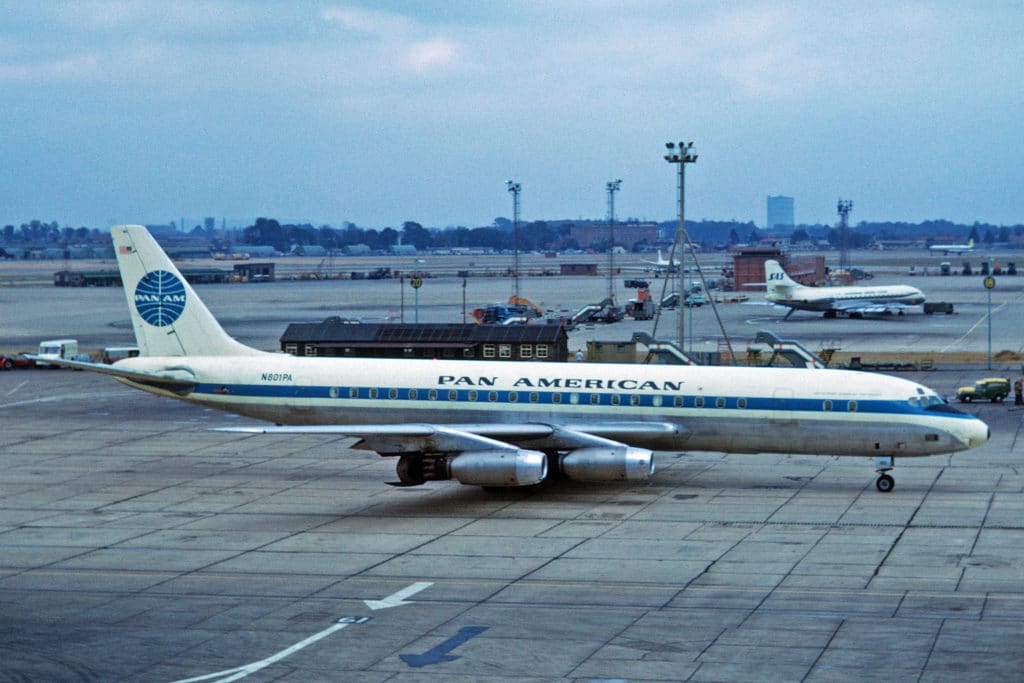
The first DC‑8, registration N8008D, rolled out on 9 April 1958. She first flew on 30 May 1958 at 14:07 hours with pilot‑in‑command C.A.G. Heimerdinger. Douglas had started late compared to Boeing’s 707, so to accelerate certification they used ten aircraft for FAA testing. Certification was granted in August 1959.
Testing resulted in several refinements, including replacing ineffective airbrakes with engine reverse thrust, adding forward wing slats to improve low‑speed lift, and enlarging wing tips to reduce drag. Production ramped up quickly, and by March 1960 Douglas reached its target of eight DC‑8s per month. The DC‑8 entered service on 18 September 1959 with both United Airlines and Delta Air Lines — though Delta maintains they were first.
On 21 August 1961, Douglas tested a new wing leading‑edge design by taking a DC‑8‑43 to 41,000 feet and putting it into a controlled dive. This aircraft, registration CF‑CPG of Canadian Pacific Air Lines, became the first civilian jet — and the first jet airliner — to break the sound barrier. Achieving Mach 1.012 (660 mph / 1,062 km/h) for 16 seconds, she was shadowed by Chuck Yeager in an F‑104 Starfighter.
Douglas soon felt the consequences of refusing to stretch the DC‑8 fuselage. Orders declined as airlines sought greater flexibility. In 1962 only 26 DC‑8s were ordered, in 1963 just 21, and in 1964 only 14 — most of them Jet Trader cargo variants. By 1965, with total orders stalling at 300, the DC‑8 program appeared to be losing momentum.
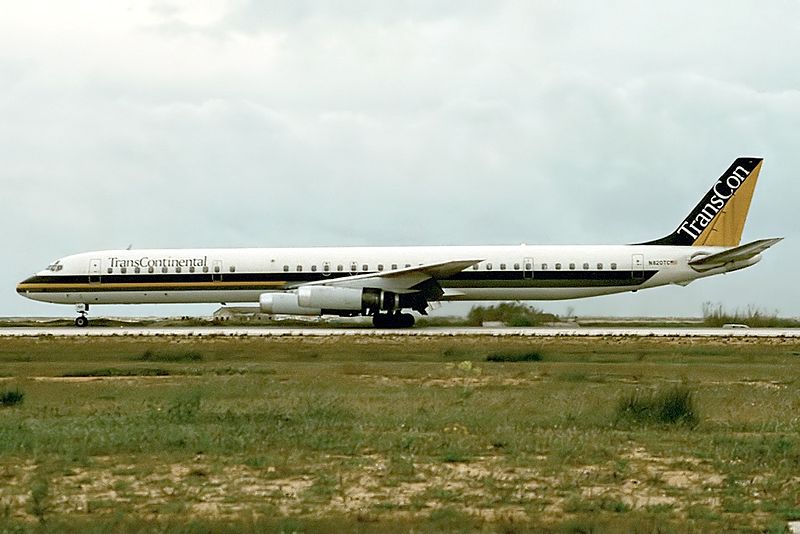
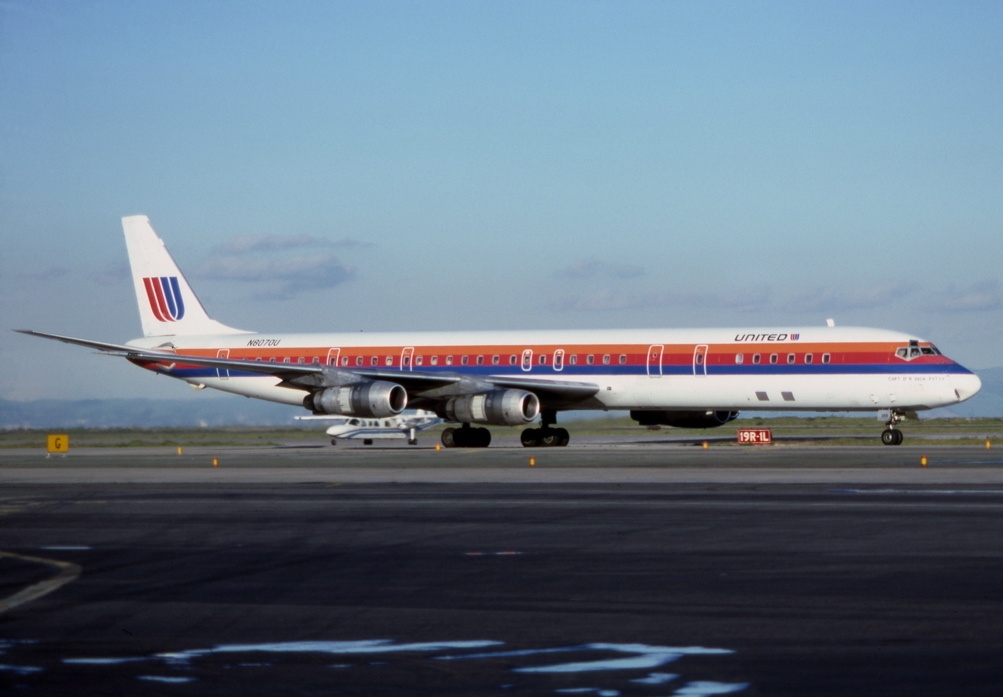
In April 1965 Douglas relented and announced the Super 60 series: the DC‑8‑61, ‑62, and ‑63. At their introduction, the ‑61 and ‑63 were the highest‑capacity airliners in the world, surpassed only by the Boeing 747 in 1970. The DC‑8‑62 was shorter, optimised for long‑range operations.
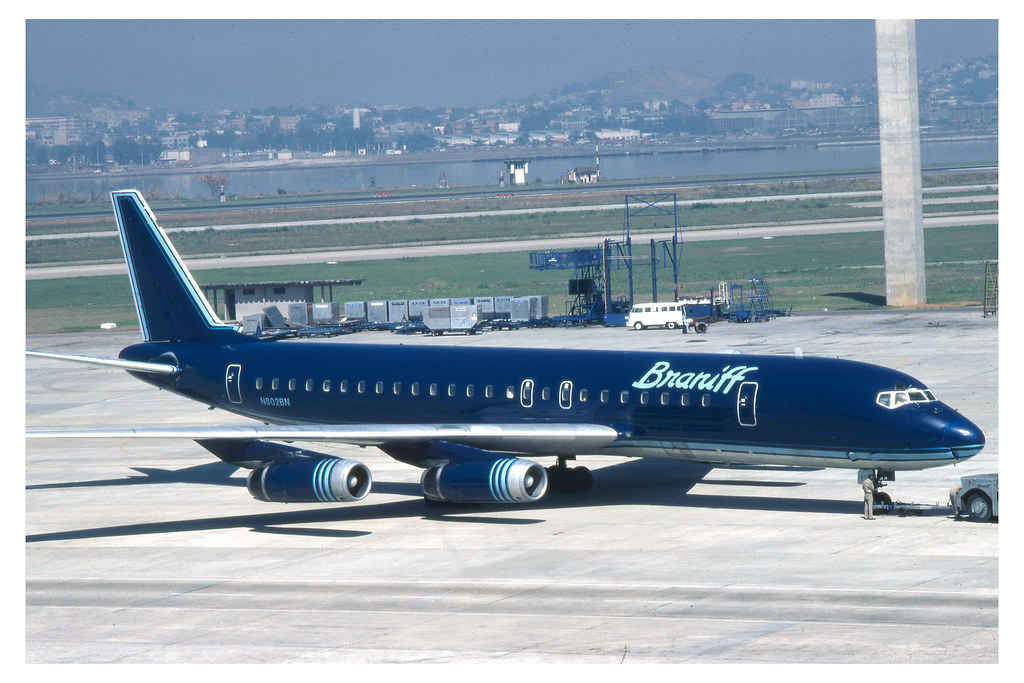
By the late 1960s, aircraft noise had become a major concern. Early pure jets were significantly louder than modern engines — and louder even than the propeller aircraft they replaced. Airports began imposing noise restrictions, forcing DC‑8‑60s to operate at lower weights to reduce thrust and noise.
Airlines asked Douglas for a solution, but the company was slow to respond. Eventually, working with General Electric, Douglas introduced the DC‑8‑70 series powered by the Franco‑American CFM56 engine.
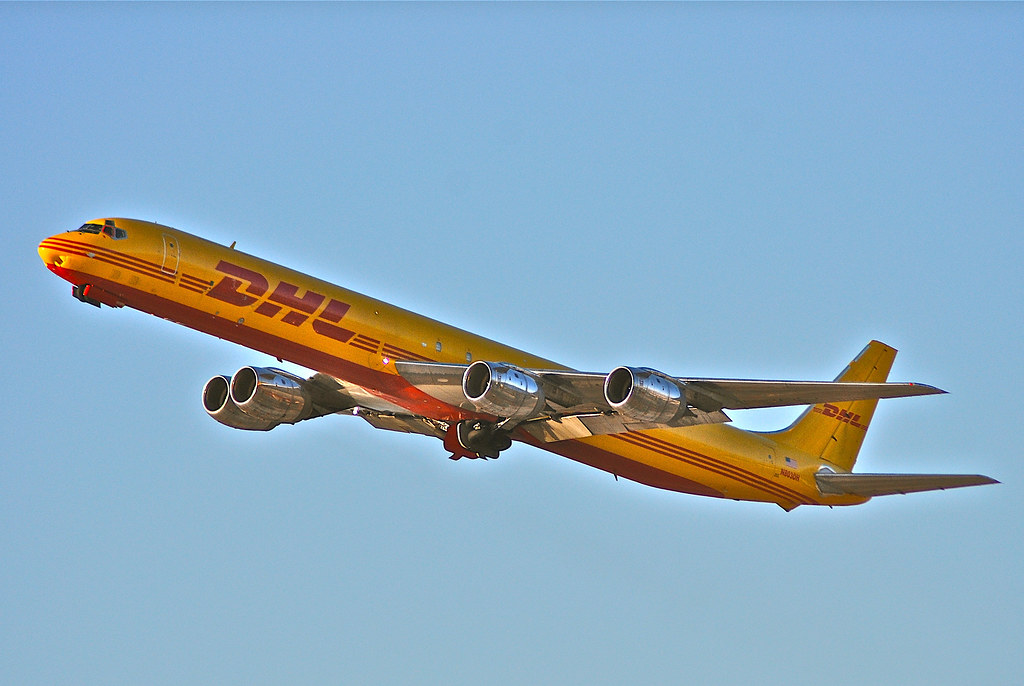
The DC‑8‑70 series was a major success. Being 70% quieter than the Super 60s, the DC‑8‑70s were the quietest four‑engine airliners of their time. The new engines were also 23% more efficient than the JT3Ds, reducing operating costs and extending range.
With 556 DC‑8s produced, the aircraft ceased production in 1972. The age of the wide‑body airliner had arrived with the Boeing 747, Douglas DC‑10, and Lockheed L‑1011 TriStar. Wide‑bodies offered lower seat‑mile costs and soon overtook narrow‑body jets. Many DC‑8s continued in service, especially with airlines unable to justify the cost of larger aircraft.
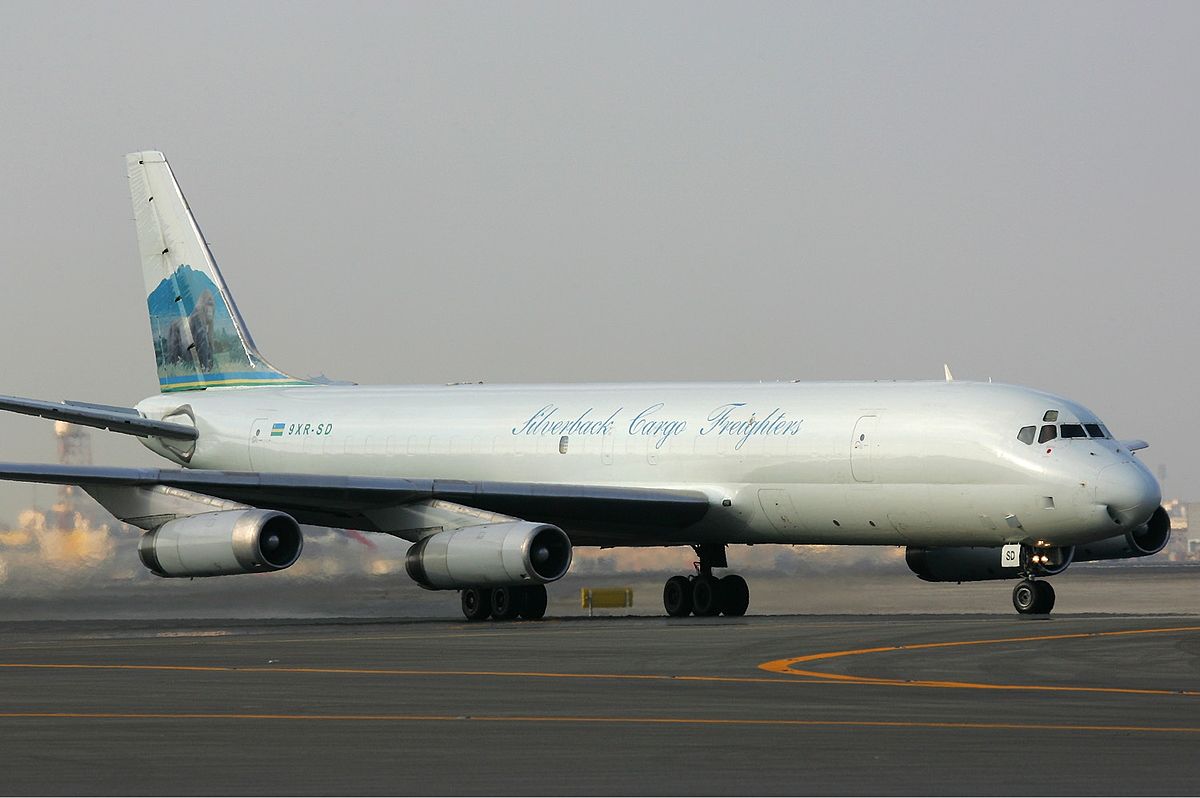
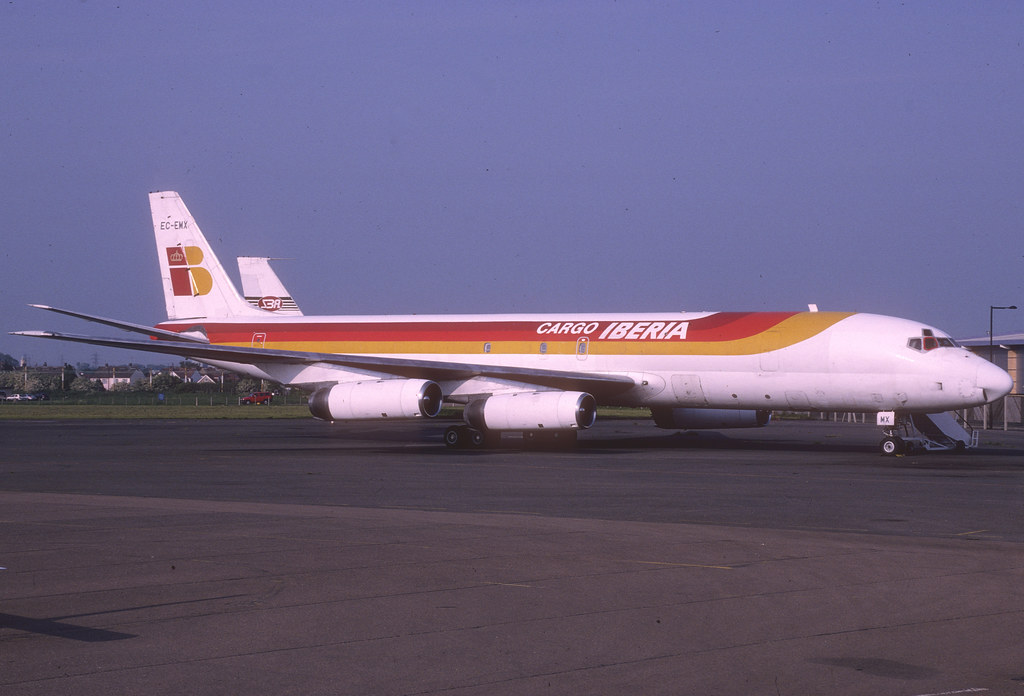
As with many older airliners, numerous DC‑8s transitioned to cargo service. Of the 556 DC‑8s built versus 1,032 Boeing 707/720s, it is notable that by 2002, around 200 DC‑8s remained in commercial service compared to only 80 707/720s. By January 2013, an estimated 36 DC‑8s were still flying.
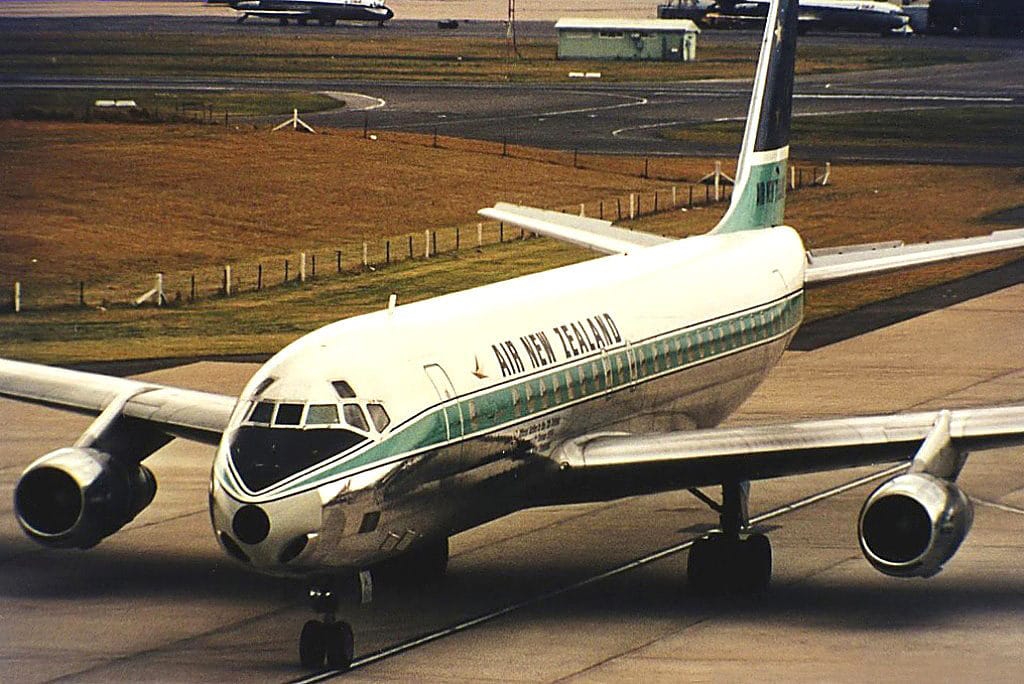
On a personal note, this airliner is one of my favourites. It was my first jet flight, immediately following my first ever flight — a DC‑3 from Faleolo, Western Samoa to Pago Pago. I flew on a TEAL (Tasman Empire Air Lines, now Air New Zealand) DC‑8 in March 1966 from Pago Pago to Auckland, with a stop in Nadi, Fiji. I remember walking under the tail to the rear stairway, in awe of the aircraft’s size and height.
Specifications
Douglas DC‑8 Specs Table
| Douglas DC‑8 | ||||||||
|---|---|---|---|---|---|---|---|---|
| Variant | Series 10 | Series 20 | Series 30 | Series 40 | Series 50 | Series 60 | Series 70 | |
| Flight Crew | 3 | |||||||
| Number Produced | 29 | 34 | 57 | 32 | 142 | 152 | 110 | |
| Dimensions | ||||||||
| Number of Passengers (1 class) | 177 | 189 | -61/-63 = 259 -62 = 189 |
-71/-73 = 259 -72 = 189 |
||||
| Aircraft Length | 45.9 m (150 ft 8 in) | -61/-63/-71/-73 = 57.1 m (187 ft 5 in) -62/-72 = 48.0 m (157 ft 6 in) |
||||||
| Height | – | – | – | – | – | – | – | |
| Wing Span | 43.4 m (142 ft 5 in) | -61/-71 = 43.4 m (142 ft 5 in) -62/-63/-72/-73 = 45.2 m (148 ft 5 in) |
||||||
| Fuselage Width | 3.73 m (12 ft 3 in) | |||||||
| Cabin Width | 3.51 m (11 ft 4 in) | |||||||
| Cargo | 39 m³ (1,390 ft³) | -61/-63/-71/-73 = 71 m³ (2,500 ft³) -62/-72 = 45.7 m³ (1,615 ft³) |
||||||
| Weights | ||||||||
| Max Takeoff Weight (MTOW) | 123,800 kg (273,000 lb) | 125,200 kg (276,000 lb) | 142,900 kg (315,000 lb) | 142,900 kg (315,000 lb) -55 = 147,400 kg (325,000 lb) |
-61 = 147,400 kg (325,000 lb) -62 = 158,800 kg (350,000 lb) -63 = 161,000 kg (355,000 lb) |
-71 = 147,400 kg (325,000 lb) -72 = 158,800 kg (350,000 lb) -73 = 161,000 kg (355,000 lb) |
||
| Operating Empty Weight (OEW) | 54,300 kg (119,797 lb) | 56,200 kg (123,876 lb) | 57,300 kg (126,330 lb) | 56,600 kg (124,800 lb) -43 = 61,900 kg (136,509 lb) |
56,600 kg (124,800 lb) -55 = 62,700 kg (138,266 lb) |
-61 = 69,000 kg (152,101 lb) -62 = 65,000 kg (143,255 lb) -63 = 72,000 kg (158,738 lb) |
-71 = 74,300 kg (163,700 lb) -72 = 69,500 kg (153,200 lb) -73 = 75,400 kg (166,200 lb) |
|
| Maximum Payload | 20,900 kg (46,103 lb) | 19,800 kg (56,200 lb) | 23,500 kg (51,870 lb) | 23,600 kg (52,000 lb) -43 = 18,900 kg (41,691 lb) |
23,600 kg (52,000 lb) | -61 = 32,600 kg (71,899 lb) -62 = 23,500 kg (51,745 lb) -63 = 32,300 kg (71,262 lb) |
-71 = 27,400 kg (60,300 lb) -72 = 19,000 kg (41,800 lb) -73 = 29,400 kg (64,800 lb) |
|
| Max Fuel | 66,245 L (17,550 US gal) | 88,552 L (23,393 US gal) | -61 = 88,552 L -62/-63 = 91,891 L |
-71 = 88,552 L -72/-73 = 91,891 L |
||||
| Performance | ||||||||
| Engines × 4 | P&W JT3C | P&W JT4A | RCo 12 | P&W JT3D‑3B | -61/62 = JT3D‑3B -63 = JT3D‑7 |
CFM56‑2 | ||
| Cruise Speed | Mach 0.82 (483 knots / 895 km/h) | |||||||
| Range | 3,760 nm (6,960 km) | 4,050 nm (7,500 km) | 4,005 nm (7,417 km) | 5,310 nm (9,830 km) -43 = 4,200 nm (7,800 km) |
5,855 nm (10,843 km) -55 = 4,700 nm (8,700 km) |
-61 = 3,200 nm -62 = 5,200 nm -63 = 4,000 nm |
-71 = 3,500 nm -72 = 5,300 nm -73 = 4,500 nm |
|
Assembly
Although Douglas initially planned to build the DC‑8 at its long‑established Santa Monica facility, the project required a runway extension to support jet operations. Local residents strongly opposed the idea of jets arriving and departing over their neighbourhood, and the request was denied. As a result, Douglas shifted DC‑8 production to Long Beach Airport, where the aircraft would ultimately be assembled.
The first DC‑8, registration N8008D, rolled out of the Long Beach factory on 9 April 1958. The facility was rapidly expanded to support the new jet program, including dedicated assembly bays, structural fabrication areas, and engine installation stations. The DC‑8’s large fuselage sections were built separately and then moved into the main assembly line, where wings, tail surfaces, landing gear, and systems were integrated.
Douglas accelerated its production processes to close the gap with Boeing’s already‑advancing 707 program. Ten DC‑8s were used during the certification campaign, allowing multiple test aircraft to operate simultaneously. This parallel testing approach helped Douglas achieve FAA certification in August 1959.
Once in full production, the Long Beach line reached a steady output of eight DC‑8s per month by March 1960. Aircraft moved down the line in stages: fuselage assembly, wing join, systems installation, interior fit‑out, engine mounting, and final checks. Each completed aircraft was then towed to the flight test area for pre‑delivery evaluation.
The introduction of the Super 60 series in 1965 required significant assembly modifications. The DC‑8‑61 and DC‑8‑63 featured major fuselage stretches, while the DC‑8‑62 incorporated structural changes for long‑range operations. These updates involved new production jigs, extended fuselage assembly stations, and revised wing and landing gear integration procedures.
Further changes arrived with the DC‑8‑70 series in the late 1970s, when many existing Super 60 aircraft were retrofitted with CFM56 engines. This conversion program required new engine pylons, strengthened wing structures, and updated systems to support the more efficient turbofan engines.
DC‑8 production continued at Long Beach until 1972, when the final aircraft was completed. Although the assembly line closed, the facility remained active for other Douglas and McDonnell Douglas programs, including the DC‑10 and later the MD‑80 series.
Orders and Deliveries
Douglas DC‑8 Customers
| Model Series | DC‑8 | |
|---|---|---|
| Airline Customers | Ordered | Delivered |
| Aeromexico | 7 | 7 |
| Air Afrique | 4 | 4 |
| Air Atlantis | 3 | 3 |
| Air Canada | 42 | 42 |
| Air New Zealand | 5 | 5 |
| Airlift International | 9 | 6 |
| Alitalia | 26 | 26 |
| American Flyers Airlines | 2 | 2 |
| ATAircraft One | 6 | 6 |
| Braniff Airlines | 7 | 7 |
| Capitol Air | 7 | 7 |
| CP Air | 11 | 11 |
| Delta Air Lines | 34 | 34 |
| Eastern Air Lines | 40 | 39 |
| Finnair | 3 | 3 |
| Flying Tiger | 19 | 19 |
| Garuda Indonesia | 5 | 1 |
| Iberia Airlines | 14 | 14 |
| Icelandair | 1 | 0 |
| Japan Airlines | 42 | 41 |
| KLM Royal Dutch Airlines | 30 | 30 |
| Lignes Aeriennes Congolaise | 4 | 2 |
| Lloyds International Leasing | 1 | 0 |
| National Airlines | 13 | 12 |
| Northwest (merged with Delta) | 5 | 5 |
| Pan Am World Airways | 20 | 20 |
| Panagra Cargo | 4 | 4 |
| Panair do Brasil | 2 | 2 |
| Philippine Airlines | 6 | 3 |
| Saturn Airways | 2 | 2 |
| Scandinavian Airlines | 26 | 26 |
| Seaboard World Airlines | 16 | 16 |
| Swissair | 11 | 11 |
| Trans Carib Air | 9 | 9 |
| Transamerica Airlines | 12 | 12 |
| Union Aeromaritime Transport | 2 | 2 |
| United Airlines | 108 | 105 |
| Universal Airlines | 2 | 2 |
| UTA | 9 | 9 |
| VIASA | 4 | 4 |
| World Airways | 3 | 3 |
| Grand Total | 576 | 556 |
Legacy
The Douglas DC‑8 occupies a significant place in aviation history as one of the pioneering jet airliners that helped usher in the modern era of long‑range travel. Although it entered the market later than the Boeing 707, the DC‑8 proved to be a durable, adaptable, and highly capable aircraft that served airlines around the world for decades.
The introduction of the Super 60 series in 1965 revitalised the program, producing some of the highest‑capacity airliners of their time. The DC‑8‑61 and DC‑8‑63 offered unmatched passenger loads until the arrival of the Boeing 747 in 1970, while the DC‑8‑62 provided impressive long‑range capability. These aircraft demonstrated Douglas’s ability to evolve the design to meet changing market demands.
The DC‑8’s longevity was further extended by the Super 70 series, which replaced the original JT3D engines with the quieter, more efficient CFM56 turbofans. This upgrade reduced noise by 70 percent and improved fuel efficiency by 23 percent, allowing many DC‑8s to continue flying well into the 1990s and early 2000s. At the time of the conversion program, the DC‑8‑70s were the quietest four‑engine airliners in service.
Although production ended in 1972 after 556 aircraft were built, the DC‑8 remained a familiar sight for decades. Its strong airframe and reliable performance made it particularly attractive to cargo operators. By 2002, around 200 DC‑8s were still in commercial service, compared with only 80 Boeing 707/720s. Even by January 2013, an estimated 36 DC‑8s were still flying.
The DC‑8’s legacy is not only technical but also personal for many travellers. For me, it holds a special place as one of my earliest aviation memories. My first jet flight was aboard a TEAL (Tasman Empire Air Lines, now Air New Zealand) DC‑8 in March 1966, travelling from Pago Pago to Auckland with a stop in Nadi, Fiji. I vividly remember walking beneath the towering tail to the rear stairway, struck by the sheer size and presence of the aircraft. It was a moment that left a lasting impression.
Today, the DC‑8 is remembered as a robust, elegant, and influential aircraft that helped define the early jet age. Its adaptability, long service life, and global reach ensured its place among the most important airliners of the 20th century.