The Airbus A350 is Airbus’ latest generation entry into the long‑haul passenger market — a mid‑sized, twin‑engined wide‑body airliner available in three variants: the A350‑800, A350‑900, and A350‑1000. The “XWB” designation stands for eXtra Wide Body, a reference to its noticeably wider cabin design. You can explore the exact dimensions in our A350 Specs section below.
What sets the A350 apart is the leap forward it represents in modern airliner technology. Its airframe makes extensive use of advanced composite materials and new construction methods — a direction similar to Boeing’s approach with the Boeing 787 Dreamliner.
It’s no surprise that many see today’s mid‑size long‑haul market as a direct contest between the Boeing 787 and the Airbus A350.
Aviation technology is evolving rapidly, and while passengers may notice only the obvious improvements — quieter cabins, better air quality, and upgraded in‑flight entertainment — aircraft like the A350 signal a much deeper shift in how airliners are built and operated. We are entering a new era in the sky.
Airbus has already demonstrated its commitment to advanced materials with the A380’s carbon‑polymer wing structure, while Boeing’s 787 introduced radical changes in both materials and manufacturing. The A350 continues this evolution, combining the lessons learned from both manufacturers into one of the most efficient wide‑body airliners ever produced.
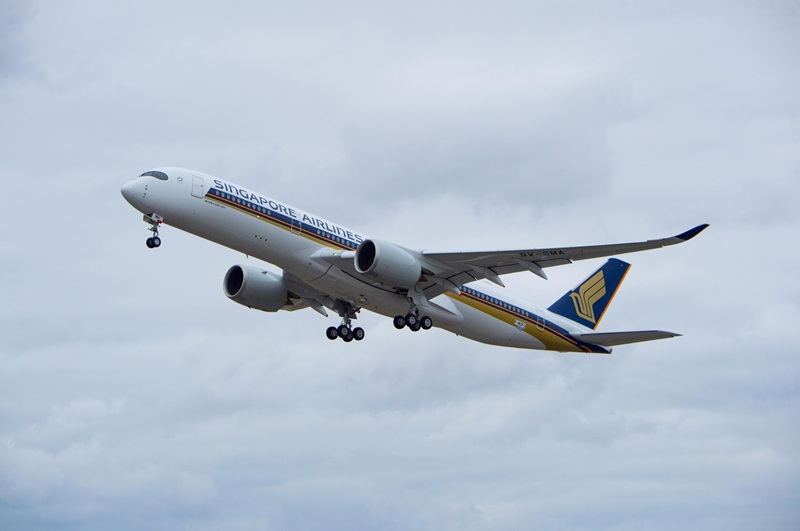
A Singapore Airlines A350-900 on its ferry flight to Singapore.
Today’s economic climate has pushed airlines to demand aircraft with lower operating costs and reduced environmental impact. Manufacturers are under increasing pressure to deliver airliners that not only burn less fuel, but also meet the ever‑stricter noise regulations imposed at major urban airports.
Developing a new aircraft is a long, complex, and extremely expensive undertaking, and the Airbus A350 XWB (Extra Wide Body) family was no exception. Like Boeing, Airbus faced strong calls from airlines to introduce a next‑generation design built with advanced materials and modern construction techniques to help reduce long‑term operating costs.
Airbus initially proposed an updated version of the popular A330 — re‑engineered with new materials and manufacturing methods — but prospective customers quickly made it clear that this would not be enough. As detailed on our Airbus A350 History page, Airbus returned to the drawing board, committed significantly more development funding, and ultimately produced what airlines were truly asking for: the all‑new A350 XWB family.
While the A350 XWB could be viewed as Airbus’ response to the Boeing 787 Dreamliner, the larger A350‑1000 also competes directly with Boeing’s successful 777 series, and serves as a natural successor to the now‑discontinued Airbus A340 family.

ASSEMBLY
The A350 assembly process is the result of major investment by Airbus in new production facilities and expanded partnerships with global suppliers.
New advances in aeronautical technology bring fresh manufacturing challenges, but also opportunities to rethink long‑standing production methods. The Airbus A350 XWB has benefited from these innovations, with improved processes that shorten build times and reduce overall production costs.
To support the A350 program, Airbus has invested heavily in the creation of ten new factories across Europe and the United States, along with significant expansions at three additional sites.
Beyond infrastructure, Airbus has also strengthened international collaboration, working closely with leading aerospace suppliers and national partners to bring the A350 XWB from concept to reality.
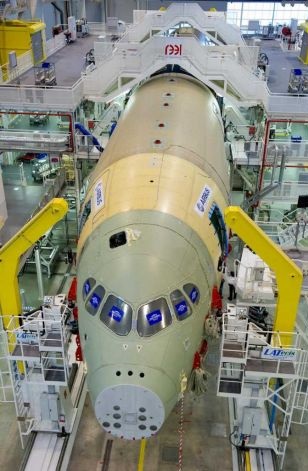
A350 Parts Manufacturers.
Avionics: As with many Airbus models, Thales will be providing the avionics.
Cabin Ergonomics and Interior Concept: BMW
Engines: Rolls Royce will be providing the Trent XWB engines for all three A350 variants.
Fuel Systems: Parker Hannifin.
Fuselage: Constructed in Illescas, Spain.
Horizontal Stabiliser Actuator: Rockwell Collins, USA.
In-flight Communications and Entertainment: Panasonic Avionics Corporation.
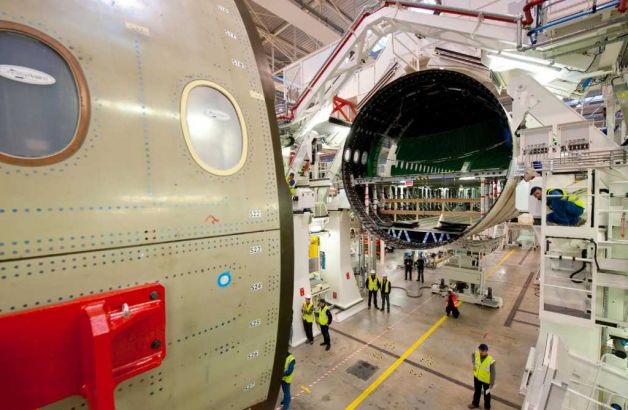
Airbus A350 fuselage sections near time to marry together.
Main undercarriage: Messier-Dowty, France.
Nose gear: Liebherr-Aerospace.
Primary Flight Control Actuators: Moog Inc.
Rudder: Construction plant in China, Airbus uses new methods which will cut the production time in half.
Thrust Reversers and Engine Nacelles: These will be provided by Goodrich Corporation, USA.
Wings: Constructed in a new building in Broughton, Wales, where some EUR745 was spent on construction. The National Assembly for Wales provided UKL28 toward the facility where the new generation composite wings would be constructed.
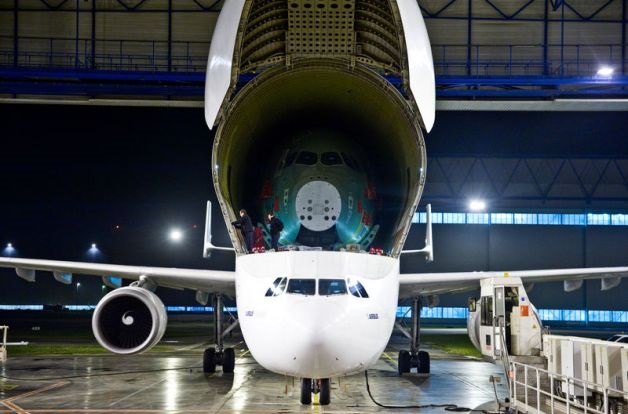
Sections of the Airbus A350 delivered by Super Beluga heavy lifters.
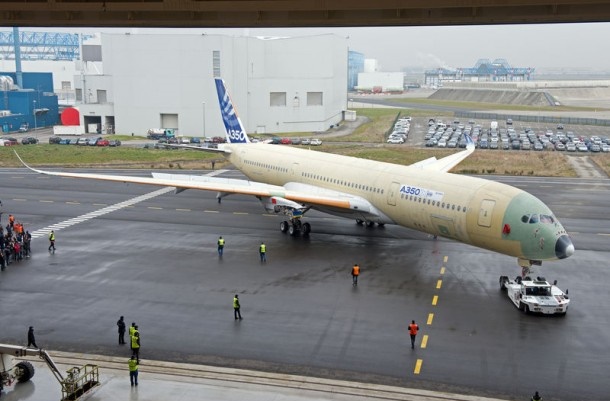
The first Airbus A350 XWB model, airframe MSN001, rolls out of the factory destined for the paint shop.
SPECIFICATIONS
The use of new materials and manufacturing methodology produces in the region of a 10% reduction in maintenance costs as well as a 14% reduction in empty weight per seat compared to competitors.
To put things in perspective the use of modern materials between the Airbus A350 XWB and its most similar competitor, the Boeing 787 read as follows:
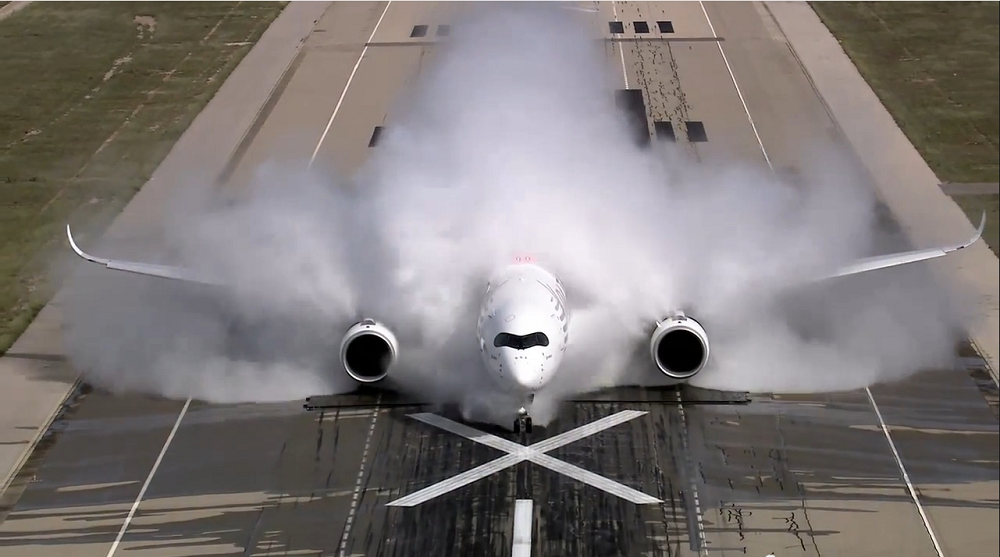
Airbus A350 wet runway water test.
Comparative use of composite materials.
| Material | Airbus A350-XWB | Boeing 787 |
|---|---|---|
| Composites | ||
| Aluminium, Aluminium-Lithium (Alu-Li) | ||
| Titanium | ||
| Steel | ||
| Miscellaneous |
The new design makes it possible to pressurise the cabin to the equivalent of pressure found at 6,000 feet (1,800 metres), with humidity at 20%. The use of composites allows for higher humidity without the risk of corrosion. The new airflow system is able to adapt to passenger numbers and adjusts accordingly with a draught-free flow.
The fuselage has a constant diameter from door 1 to door 4 thereby not only maximising space available inside the aircraft but standardising all doors so that not so many spare parts have to be carried.
The fuselage, as the designator XWB (Extra Wide Body) would indicate, is remarkable in that it is wider than both the A330 and A340 models. The A350 XWB has an external cabin width of 5.97 metres (19.6 feet) against the A330/A340 at 5.64 metres (18.5 feet).
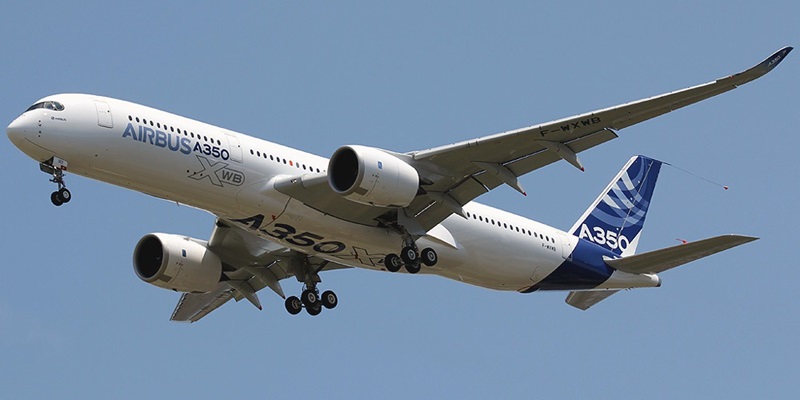 Airbus A350-900 Reg F-WXWB prototype showing off the wing configuration during landing.
Gone are the traditional Airbus wingtip fences, to be replaced with a sabre like point taking up the outer 4.4 meters (14 feet) of the wing. The high-lift trailing edge of the wing uses the same hinge system as the A380 with spoilers covering the gap created when flaps are extended. The new wing design allows a cruising speed of mach .85 with a maximum operating speed of mach .89.
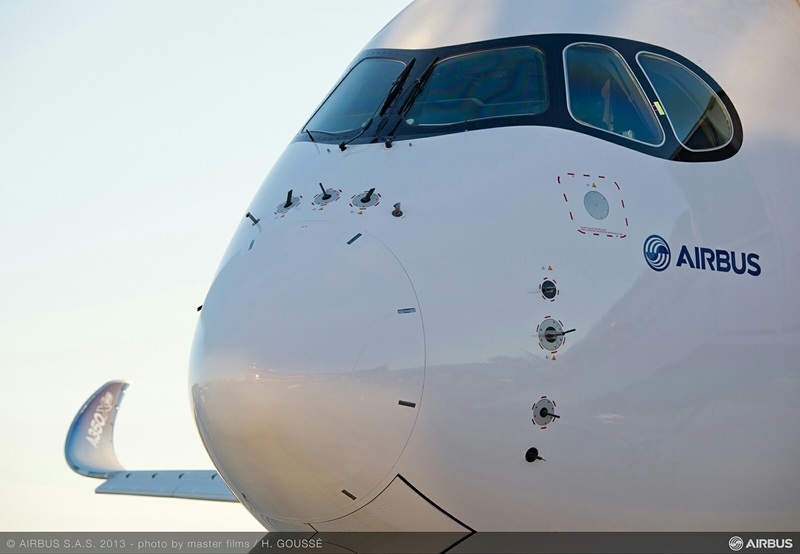
Cockpit windshields on the A350.
A trade-off study was conducted to determine the best construction material for the forward section. Composite materials would have been an obvious choice due to weight benefits, however, extra strength is required to allow for bird strikes and if composites were employed then extra titanium would be required to bolster the strength. The decision was made to go with aluminium.
Instead of the traditional 4 flight deck windows, A350 XWB has 6 giving not only a wider field of vision but also with the spread of the load carried by the window posts the centre post can be thinner improving forward vision.
The A350 XWB cockpit carries 6 LCD screens of a 38cm (15in) diameter. Two are located in the centre of the panel one above the other above the thrust levers. Each pilot has their own primary, flight and navigation panels. The system is designed to allow for the addition of new technology as it comes in the future.
Pilots also benefit from a Head Up display (HUD), where primary information is projected onto a clear screen in their forward line of sight much like fighter pilots so that they never have to take their eyes off the outside world.
The Integrated Modular Avionics (IMA) found on the A380 have been improved upon with the system handling 40 functions against the A380s 23. These include functions such as; Undercarriage, air systems, pneumatics and fuel. The benefits, of course, will be weight reduction as fewer processors are required on board, as well as a more stable system running a 100 Megabit per second network.
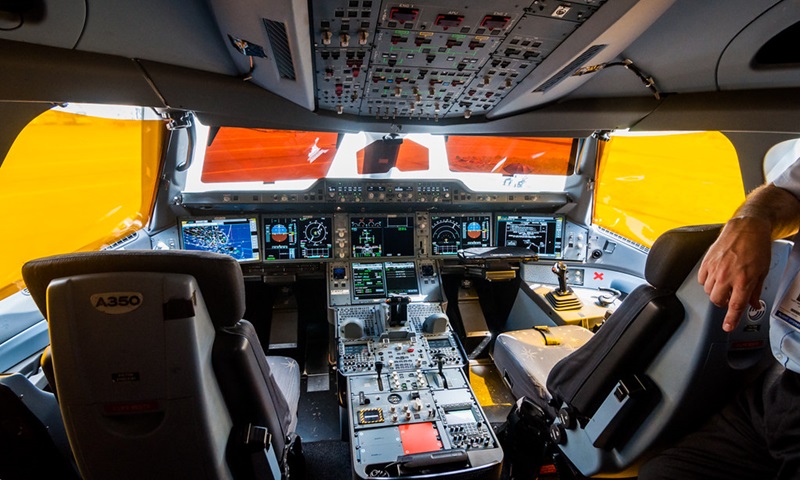
Cockpit of A350 XWB showing the large LCD screens.
Advanced technology gained on the creation of the Trent 900 for the A380 and Trent 1000 for the Boeing 787 will obviously benefit the A350 XWB. In addition, the advances in noise dampening ensure that A350 XWB has state-of-the-art solutions.
Airbus has adopted a three-prong main landing gear configuration with the two main prongs attached to the rear wing spar forward and to a gear beam to the rear which is itself attached to the wing and fuselage. The use of composite materials in wing construction requires a more even distribution of weight. The main gear comes in four and six-wheel bogies. Four for the -800 and -900 variants and six for the heavier longer range -1000 and also the -900r being proposed for British Airways to enable a London to Sydney non-stop type range.
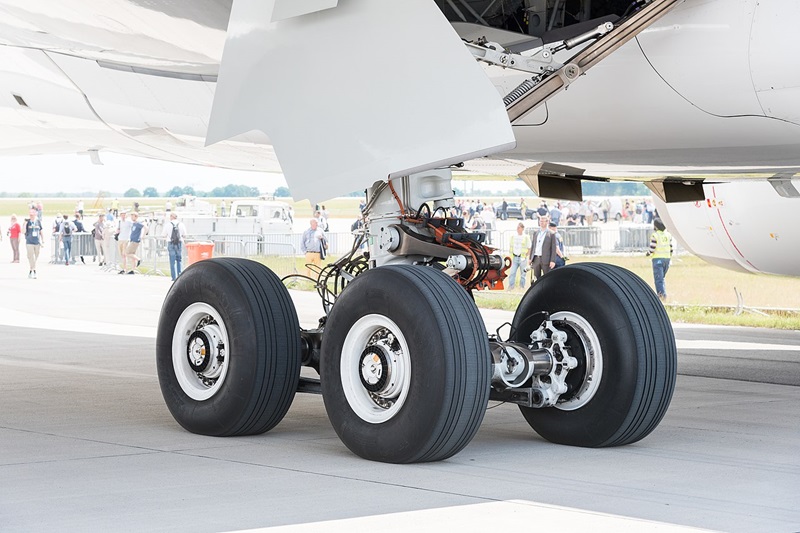
An example of the 4-wheel main landing gear bogie on an Airbus A350-941, Reg F-WWCF Airframe MSN002 at ILA Berlin June 2016
Airbus A350 XWB Specs Table
| A350-800 | A350-900 | A350-1000 | |
|---|---|---|---|
| Range | 15,700Km (8,300NM) | 15,000Km (8,100NM) | 15,600Km (8,400NM) |
| Seating (Typical) | 270 | 314 | 350 |
| Replaces Current Model | A330-200 | A340-300 | A340-600 |
| Listed Airbus A350 Price | US$269.5 Million | US$304.8 Million | US$351.9 Million |
| Competes against | Boeing 787-9 | Boeing 777-200ER | Boeing 777-300ER |
| Length | 60.54 Metres | 66.89 Metres | 73.88 Metres |
| Wing span | 64.75 Metres | 64.75 Metres | 64.75 Metres |
| Height | 17.10 Metres | 17.10 Metres | 17.10 Metres |
| Fuselage Width (Exterior) | 5.96 Metres | 5.96 Metres | 5.96 Metres |
| Cabin width (Interior) | 5.61 Metres | 5.61 Metres | 5.61 Metres |
| Track | 10.60 Metres | 10.60 Metres | 10.70 Metres |
| Wheelbase | 24.86 Metres | 28.67 Metres | 33.10 Metres |
| Freight (underfloor) LD3 | 28 | 36 | 44 |
| Freight (underfloor) Pallets | 9 | 11 | 14 |
| Freight (underfloor) Bulk | 11.3 Cubic Metres | 11.3 Cubic Metres | 11.3 Cubic Metres |
| Freight (underfloor) Total | 136.6 Cubic Metres | 172.3 Cubic Metres | 208.1 Cubic Metres |
| Maximum Operating Speed | Mach 0.89 | Mach 0.89 | Mach 0.89 |
| Maximum Ramp Weight | 248.9 tonnes | 268.9 tonnes | 308.9 tonnes |
| Maximum Take off Weight | 248.0 tonnes | 268.0 tonnes | 308.0 tonnes |
| Maximum Landing Weight | 190.0 tonnes | 205.0 tonnes | 233.0 tonnes |
| Maximum Zero Fuel Weight | 178.0 tonnes | 192.0 tonnes | 220.0 tonnes |
| Maximum Fuel Capacity | 138,000 Litres | 138,000 Litres | 156,000 Litres |
| Engines – Rolls Royce Trent XWB | RR Trent XWB 337kN (74,000 LBF) | RR Trent XWB 374kN (83,000 LBF) | RR Trent XWB 432kN (97,000 LBF) |
| Average unit price in USD millions. | 260.9 | 295.2 | 340.7 |
When Boeing announced the development of the Boeing 787 Dreamliner, Airbus didn’t immediately respond as they took this to be Boeings’ reaction to the Airbus A330. When it became evident that the Boeing 787 would be a far more advanced aircraft in its systems and use of composite materials, Airbus proposed a modernisation of the Airbus A330.
This would have been called the A330 200 Lite with redesigned wings and engines of the new generation as offered by the Boeing 787.
This offering was nipped in the bud very quickly by Airbus prospective customers and was never announced at the Farnborough Airshow in 2004 as intended. They demanded an all new aircraft, a completely new design from the ground up.
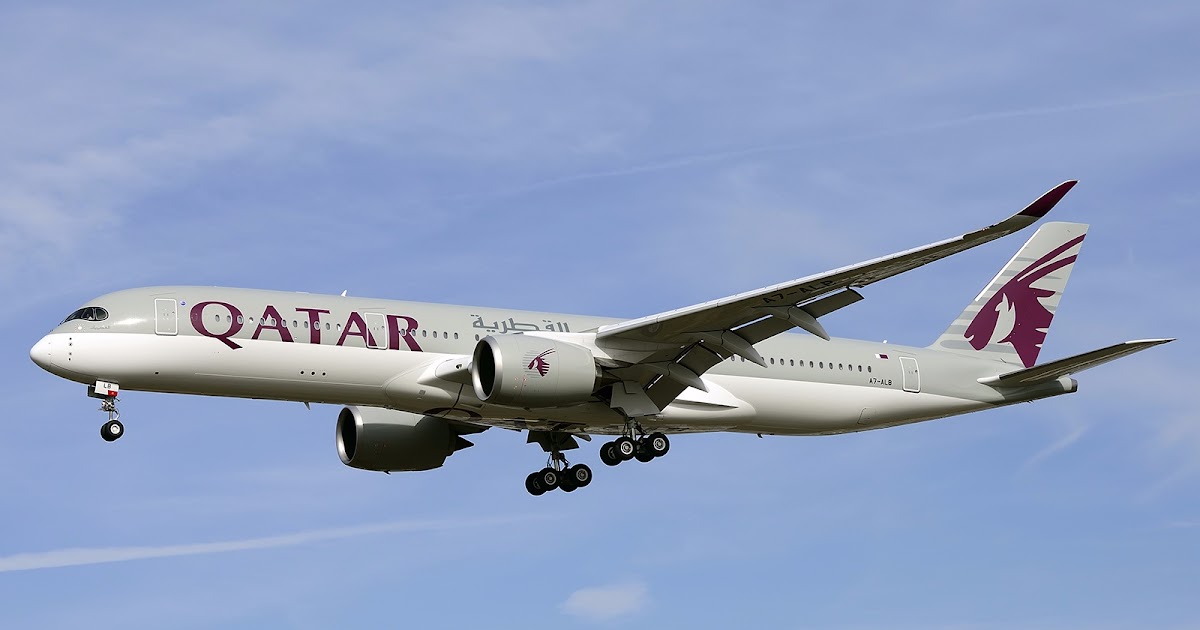
Airbus A350-900 of Qatar Airways on approach for landing at Frankfurt
Airbus A350 History Timeline.
10 December 2004: The EADS board as well as the BAe board, who were at that time shareholders of Airbus, voted to give Airbus an Authorisation To Offer (ATO), and gave the designation of A350.
16 June 2005: At the Paris Airshow, Qatar Airways places an order for 60 Airbus A350 XWB aircraft.
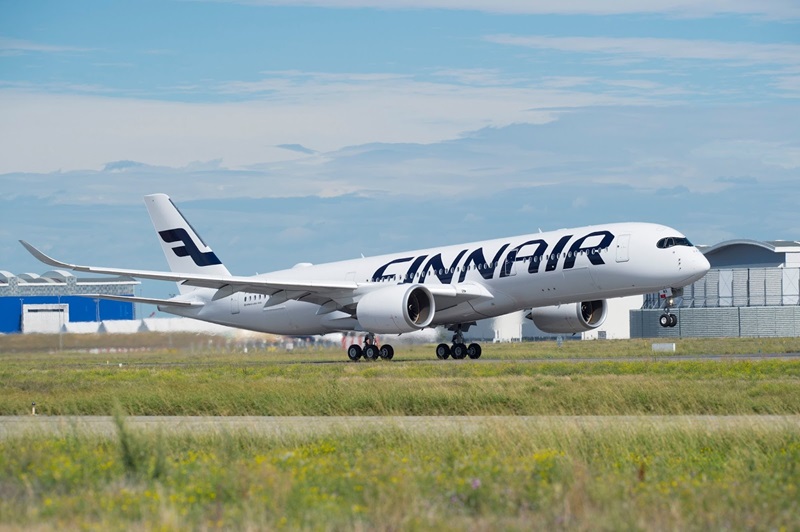
Finnair A350 on First Flight in Toulouse.
Airbus would offer two versions of the A350:
-The A350-800 would be capable of flying 8,800 nm (16,300 km) with a typical passenger load of 253 in a 3-class configuration.
-The A350-900 would be capable of flying 7,500 nm (13,900 km) with a typical passenger load of 300 in a 3-class configuration
This ensured that Airbus addressed competition with both the Boeing 777-200ER and Boeing 787-9.
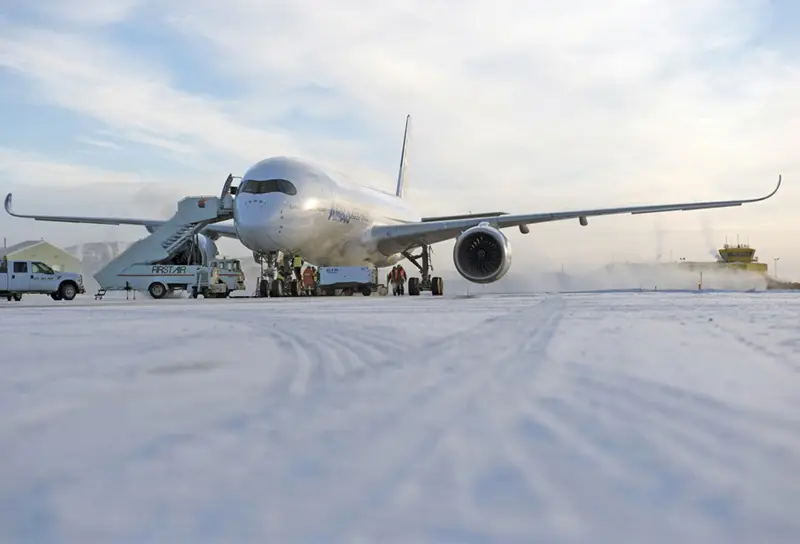
Airbus A350 Airframe MSN3 conducting cold weather tests at Iqaluit Canada.
14 July 2006: Once again at the Farnborough Airshow Airbus announced the new completely redesigned aircraft would be designated the Airbus A350 XWB (Extra Wide Body). There was a rumour that the new aircraft would be designated the A370 or even the A280. This could have been fueled by an erroneous advertisement run by Airbus on the Financial Times website. Within a few days, an order was placed by Singapore Airlines for 20 of the new jet with options for 20 more. Airbus received accolades for coming up with a completely new design for the A350.
September 2006: Qatar Airways signs with General Electric to provide the GEnx-1A-72 for the Airbus Industries A350 XWB.
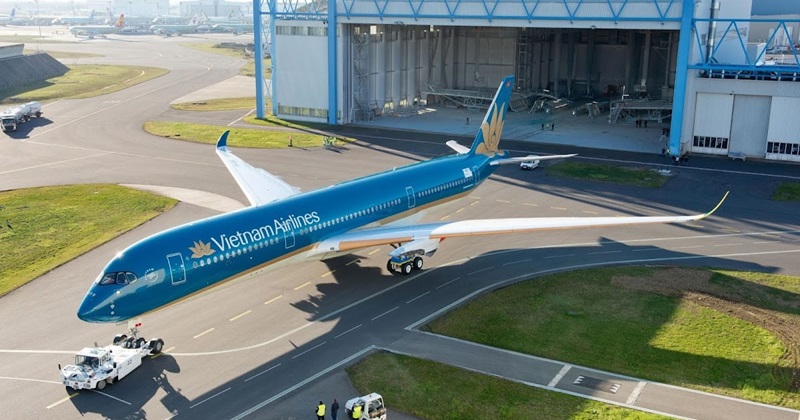
A Vietnam Airlines A350-900 rolls out of the paint shop.
01 December 2006: Delays with the Airbus A380 program meant that the board of Airbus did not finally approve the development of the A350 until this date. Airbus resources were very stretched at this time and the go-ahead was still not a certainty. Finally, the decision was reached to fund the development from cash flow, and the go-ahead was given for the first delivery of the A350 900 XWB in mid-2013, the first A350 800 XWB in 2014 and the A350 1000 XWB in 2015.
04 December 2006: Some new details of the design were released to the public. It was also revealed that re-negotiations were taking place with existing order holders due to the increased cost of the redesigned A350 XWB.
04 January 2007: Airbus announces that a firm order for 2 aircraft had been placed by Pegasus Aviation Finance Company.
The change to the design of the A350 XWB caused an extra two years to be added to the development program. As a result, the estimated development costs doubled from EUR5.5 Billion to almost EUR10 Billion. Airbus stressed that the first delivery dates would remain unchanged, however, the first flights would be delayed. The testing program would be reduced from 15 months to 12 months.
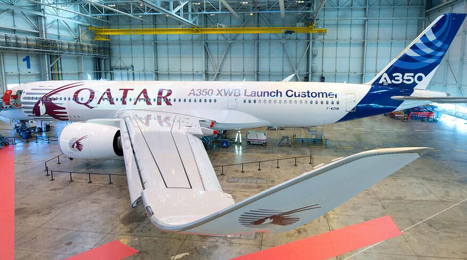
A350-900 test aircraft honouring launch customer Qatar.
January 2008: Thales Group wins the contract to provide avionics for the A350, a EUR2 Billion contract over 20 years.
12 November 2010: Airbus announces that the first delivery date would slip from mid-2013 to late 2013 due to the complexities of moving from the design to manufacturing phases.
29 December 2011: The first forward fuselage section was delivered to the factory.
05 April 2012: Construction and assembly of the first static A350 model is started.
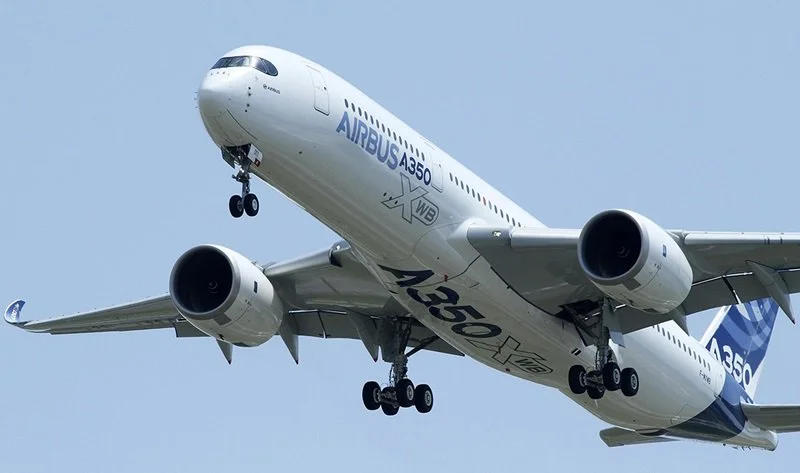
Airbus A350 XWB in Airbus house colours landing.
14 June 2013: Maiden flight of the A350. At Toulouse-Blagnac airfield with thousands of spectators and Airbus employees looking on, the A350 XWB made its maiden flight. The four-hour flight was undertaken by a team of six wearing orange jumpsuits and parachutes flying over the Pyrenees Mountains.
Chief Test Pilot Peter Chandler reported from 13,000 feet that the aircraft was handling extremely well. Much of the testing was focused on the flaps and landing gear. The first stage of the flight was conducted with the landing gear extended.
The timing of the maiden flight was no accident with the Paris Airshow set to begin on Monday 17 June. Airbus now had the maiden flight under its belt as it prepared to go head-to-head with the Boeing 787. The order book for the A350 stood at 616, which included an order for 50 units from Singapore Airlines received during this month.
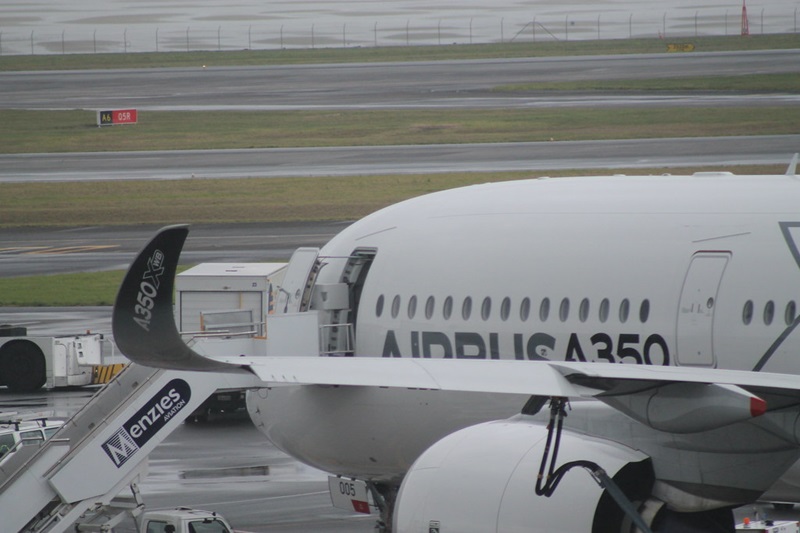
Airbus A350 XWB airframe MSN 005 registration F-WWYB showing off the sabre wing tip.
21 June 2013: Toward the end of its third test flight, the aircraft with in-house designation MSN1 made its first public appearance when it made a show-stopping entrance at the Paris Airshow around 13:30. The A350 XWB made a pass down the Le Bourget main show runway to thunderous applause from the crowd. The aircraft then gracefully climbed into the cloud and was gone.
29 July 2013: A virtual commercial flight of 5 hours was conducted on the ground in Hamburg. 129 passengers, 2 pilots and 8 cabin crew took part in em-planing, deplaning and normal in-flight activities as part of early testing of the human factors of flight.
14 October 2013: The second A350 XWB test aircraft with in-house designator MSN3 took to the skies from Toulouse-Blagnac Airport France at around 14:30. Like MSN 1 the aircraft was devoid of a cabin interior but carried heavy testing equipment instead.
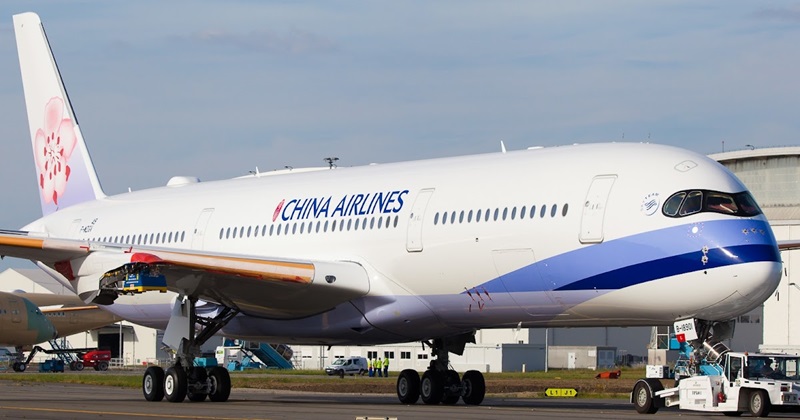
A350-900 China Airlines Toulouse Blagnac.
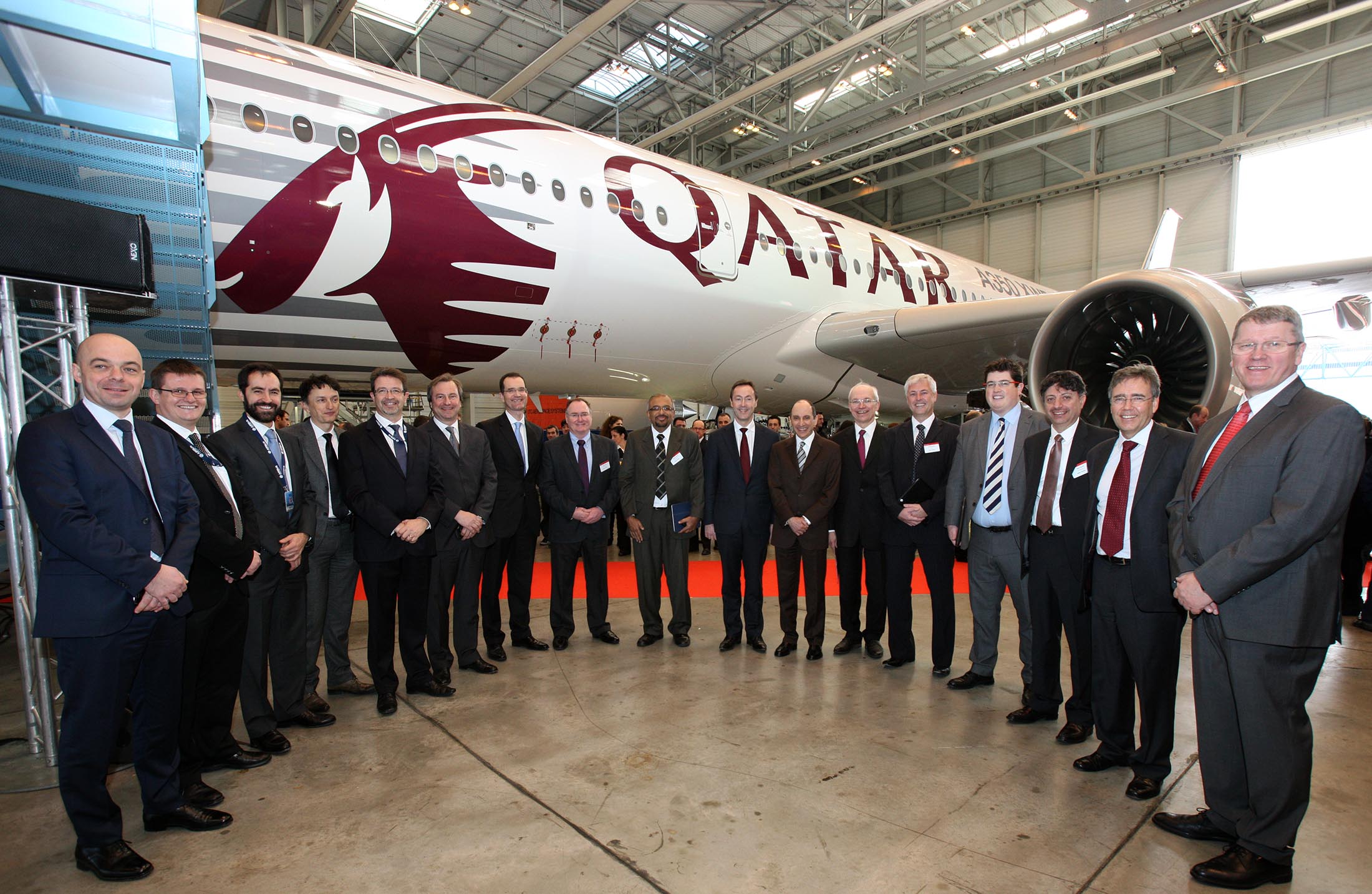
22 December 2014: Qatar Airways, the launch customer for the A350 XWB took delivery of their first Qatar A350.
15 January 2015: The first commercial service of the Airbus Industrie Airbus A350 XWB was flown from Doha to Frankfurt.
25 September 2015: Construction starts on the first A350 1000.
24 November 2016: The A350 1000 stretched version takes to the air for its maiden flight at 10:42 am from Toulouse Le Blagnac airfield. The test flight lasted just over four hours and began the giant A350’s rigorous certification program.
21 November 2017: In just under a year since her maiden flight the Airbus A350-1000 gained type certification from both the F.A.A. (Federal Aviation Authority of the U.S.A.) and European Aviation Safety Agency (E.A.S.A.). At the time of this event, the A350-1000 had orders from 11 customers for a total of 169 airframes.
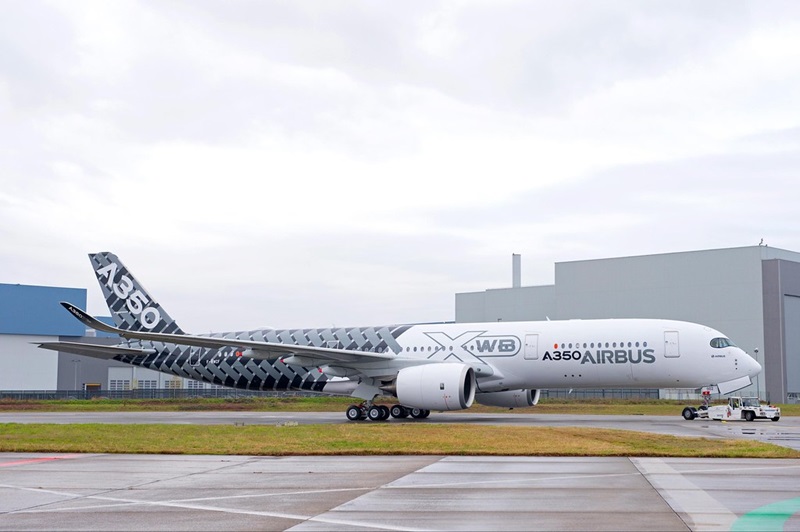
Airbus A350 XWB Carbon Livery.
Cabin Interior.
Some Airbus A350 example cabin layouts.
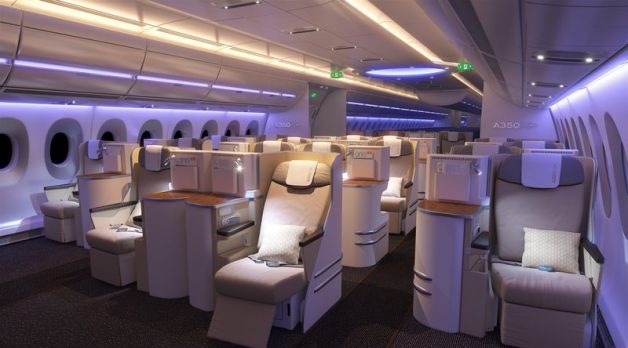
Airbus A350 XWB Business class option.
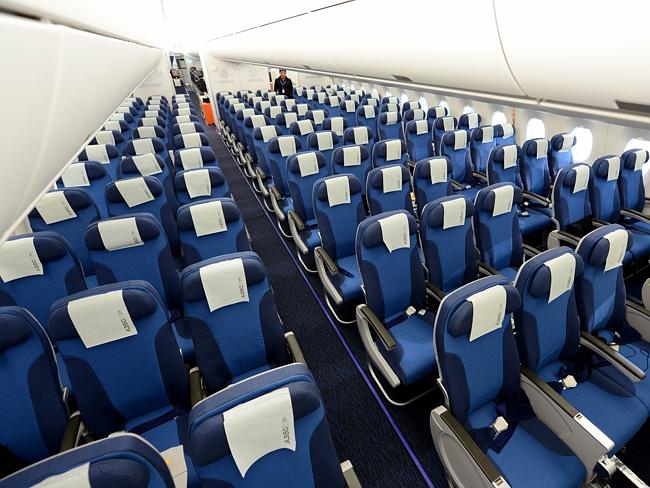
Airbus A350 XWB interior economy cabin 9 abreast looking rearwards.
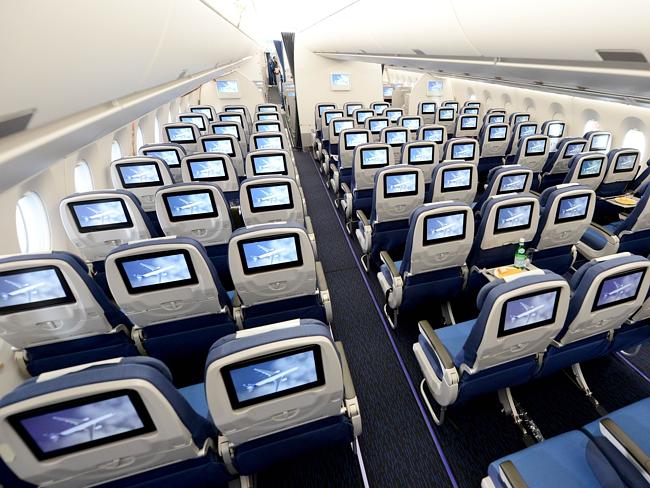
Airbus A350 XWB interior economy cabin 9 abreast looking forward.
The feeling of space is further enhanced by the size of the windows which are wider than competitors providing more of a panoramic view and enabling those passengers not in window seats to also see outside. The new materials and construction methods will enable the cabin to be pressurised to the equivalent pressure found at around 6,000 feet of altitude. Passengers will also arrive more refreshed as an average humidity of 20% can be maintained.
As well as a crew rest area in the ceiling just behind the flight deck for flight crew, there is also one for cabin crew located in the tail which can accommodate six to eight bunks. The area will provide a space to stand at full height to enable easy dressing.
Some Airbus A350 XWB example cabin configurations.
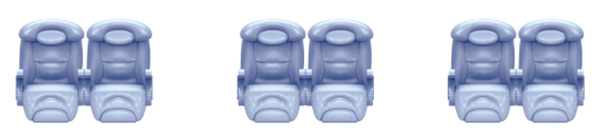
Business ClassLong Haul – Six abreast.
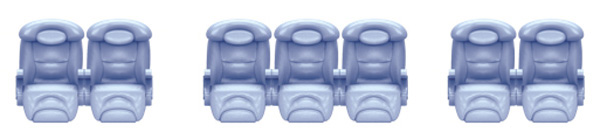
Short to Medium Haul – Seven abreast.
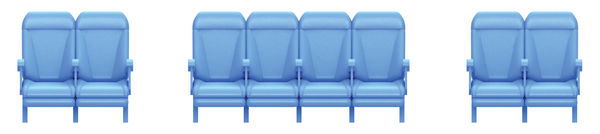
Premium Economy – Eight abreast.
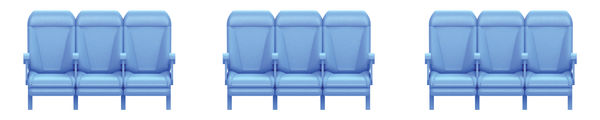
Economy – Nine abreast.
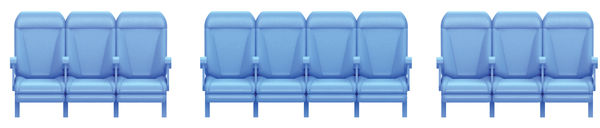
High-Density Economy – Ten abreast.
Orders and Deliveries.
The launch airline has extensive input into the finished product while at the same time being able to negotiate a favourable price for their order. The risk, and therefore the reason that the launch carrier can negotiate such a favourable unit price for their order is that there can be delays. The Airbus A350 XWB is no different. New technology and so far untried new methods can lead to delays when things don’t go to plan. A very obvious example of this was the launch of the Boeing 787 Dreamliner which ran into all sorts of problems and led to extensive delays.
Qatar Airways was the launch customer for two variants of the A350. The first of course was the A350-900 which was delivered on 22 December 2014. This was followed by the A350-1000 which was delivered on 20 February 2018. This A350-1000 was the first to be fitted with the revolutionary new Qsuite seats, a new innovation in Business Class seat that makes up into a double bed.
Orders and Deliveries Summary
| A350-F | A350-900 | A350-1000 | Totals | |
|---|---|---|---|---|
| Orders | 31 | 748** | 140 | 888 |
| Deliveries | – | 442** | 67 | 509 |
| Operational | – | 442 | 67 | 509 |
Correct to end November 2022
**excludes 2 A350-900 delivered to ITA AIRWAYS via AIRBUS FINANCIAL SERVICES
**excludes 2 A350-900 AEROFLOT under sanctions
Airbus A350 Order Book.
| A350-F | A350-900 | A350-1000 | ||||||||||
|---|---|---|---|---|---|---|---|---|---|---|---|---|
| ORD | DEL | OP | ORD | DEL | OP | ORD | DEL | OP | ||||
| Govt. Exec and Private Jets | 5 | 4 | 4 | |||||||||
| Aercap (leasing) | 20 | 20 | ||||||||||
| Aeroflot | 16 | 7 | 4 | |||||||||
| Afriqiyah Airways | 10 | |||||||||||
| Air Caraibes | 3 | 4 | 2 | 3 | ||||||||
| Air China | 30 | 20 | 20 | |||||||||
| Air France | 4 | 38 | 20 | 20 | ||||||||
| Air Lease Corporation | 7 | 18 | 13 | 8 | 6 | |||||||
| Air Mauritius | 4 | 2 | 4 | |||||||||
| Alafco | 12 | 12 | ||||||||||
| A350-F | A350-900 | A350-1000 | ||||||||||
| ORD | DEL | OP | ORD | DEL | OP | ORD | DEL | OP | ||||
| Asiana Airlines | 30 | 13 | 13 | |||||||||
| Azul | 4 | |||||||||||
| BOC Aviation | 2 | 2 | ||||||||||
| British Airways | 18 | 13 | 13 | |||||||||
| Cathay Pacific | 28 | 26 | 28 | 18 | 17 | 17 | ||||||
| China Airlines | 14 | 14 | 14 | |||||||||
| China Eastern | 20 | 14 | 14 | |||||||||
| China Southern Airlines | 20 | 15 | 16 | |||||||||
| C.I.T. Leasing | 7 | 7 | ||||||||||
| CMA CGM | 4 | |||||||||||
| DAE Capital | 2 | 2 | ||||||||||
| Delta Airlines | 25 | 18 | 27 | |||||||||
| Emirates | 50 | |||||||||||
| Ethiopian Airlines | 18 | 17 | 19 | 4 | ||||||||
| Etihad Airlines | 7 | 20 | 5 | 5 | ||||||||
| Evelop Airlines | 2 | |||||||||||
| Fiji Airways | 2 | |||||||||||
| Finnair | 19 | 17 | 17 | |||||||||
| French BEE | 4 | 1 | ||||||||||
| GROUPE DUBREUIL | 1 | 1 | ||||||||||
| Hainan Airlines | 7 | |||||||||||
| Hong Kong Airlines | 3 | 3 | 2 | |||||||||
| Iberia | 20 | 15 | 15 | |||||||||
| A350-F | A350-900 | A350-1000 | ||||||||||
|---|---|---|---|---|---|---|---|---|---|---|---|---|
| ORD | DEL | OP | ORD | DEL | OP | ORD | DEL | OP | ||||
| Iran Air | 16 | |||||||||||
| ITA Airways | 4 | |||||||||||
| Japan Airlines | 18 | 16 | 16 | 13 | ||||||||
| Kuwait Airways | 2 | |||||||||||
| Latam Airlines Group | 13 | 13 | ||||||||||
| Libyan Airlines | 6 | |||||||||||
| Lufthansa | 45 | 17 | 21 | |||||||||
| Malaysia Airlines | 6 | |||||||||||
| Philippine Airlines | 6 | 6 | 2 | |||||||||
| QANTAS Airways | 12 | |||||||||||
| Qatar Airways | 34 | 34 | 34 | 19 | 19 | 19 | ||||||
| Scandinavian Airlines | 8 | 6 | 6 | |||||||||
| Sichuan Airlines | 10 | 1 | 4 | |||||||||
| Silk Way West Airlines | 2 | |||||||||||
| Singapore Airlines | 7 | 65 | 61 | 61 | ||||||||
| Sri Lankan Airlines | 4 | |||||||||||
| Starlux | 17 | 1 | 1 | |||||||||
| Thai International | 4 | 4 | 12 | |||||||||
| Turkish Airlines | 26 | 11 | 11 | |||||||||
| United Airlines | 45 | |||||||||||
| Vietnam Airlines (Aercap) | 10 | 10 | 14 | |||||||||
| Virgin Atlantic | 8 | 5 | 9 | |||||||||
| World2fly | 2 | |||||||||||
| Yemenia Yemen Airways | 10 | |||||||||||
| Undisclosed | 13 | 9 | ||||||||||
| Totals | 31 | 748 | 442 | 442 | 140 | 67 | 67 | |||||
| ORD | DEL | OP | ORD | DEL | OP | ORD | DEL | OP | ||||
| A350-F | A350-900 | A350-1000 | ||||||||||